
Microsoft DP-100 Dumps - 100% Cover Real Exam Questions (Updated 230 Questions)
Real DP-100 dumps - Real Microsoft dumps PDF
NEW QUESTION 53
You need to select a feature extraction method.
Which method should you use?
- A. Mutual information
- B. Permutation Feature Importance
- C. Kendall correlation
- D. Mood's median test
Answer: C
Explanation:
In statistics, the Kendall rank correlation coefficient, commonly referred to as Kendall's tau coefficient (after the Greek letter τ), is a statistic used to measure the ordinal association between two measured quantities.
It is a supported method of the Azure Machine Learning Feature selection.
Note: Both Spearman's and Kendall's can be formulated as special cases of a more general correlation coefficient, and they are both appropriate in this scenario.
Scenario: The MedianValue and AvgRoomsInHouse columns both hold data in numeric format. You need to select a feature selection algorithm to analyze the relationship between the two columns in more detail.
Reference:
https://docs.microsoft.com/en-us/azure/machine-learning/studio-module-reference/feature-selection-modules
NEW QUESTION 54
You need to modify the inputs for the global penalty event model to address the bias and variance issue.
Which three actions should you perform in sequence? To answer, move the appropriate actions from the list of actions to the answer area and arrange them in the correct order.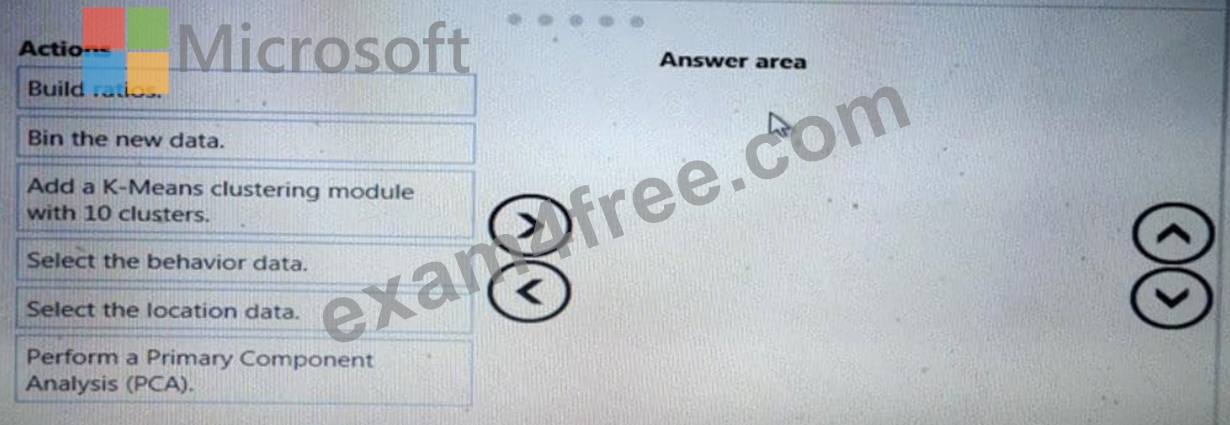
Answer:
Explanation: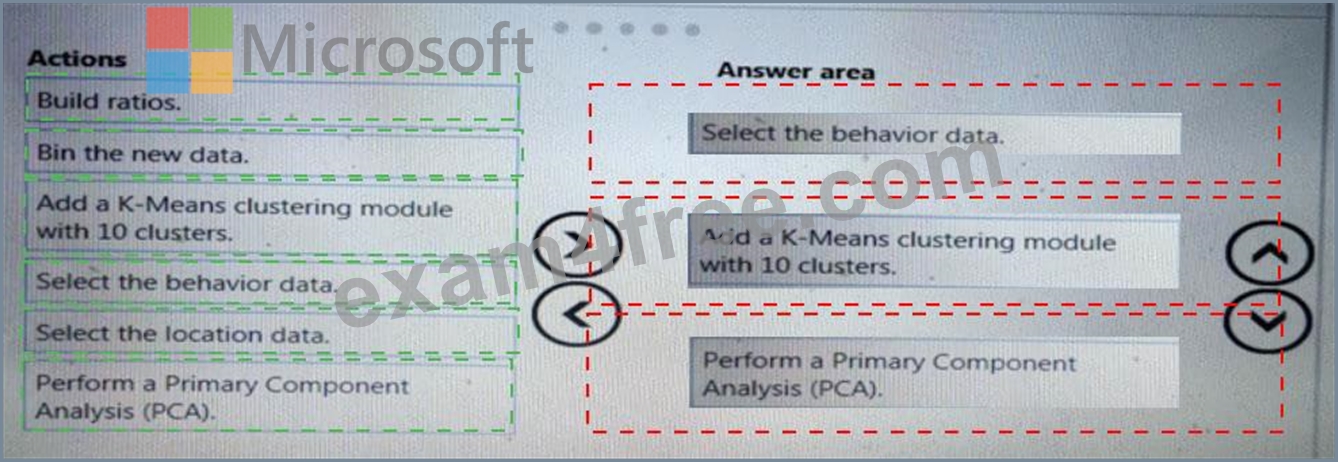
Topic 2, Case Study 2
Case study
Overview
You are a data scientist for Fabrikam Residences, a company specializing in quality private and commercial property in the United States. Fabrikam Residences is considering expanding into Europe and has asked you to investigate prices for private residences in major European cities. You use Azure Machine Learning Studio to measure the median value of properties. You produce a regression model to predict property prices by using the Linear Regression and Bayesian Linear Regression modules.
Datasets
There are two datasets in CSV format that contain property details for two cities, London and Paris, with the following columns: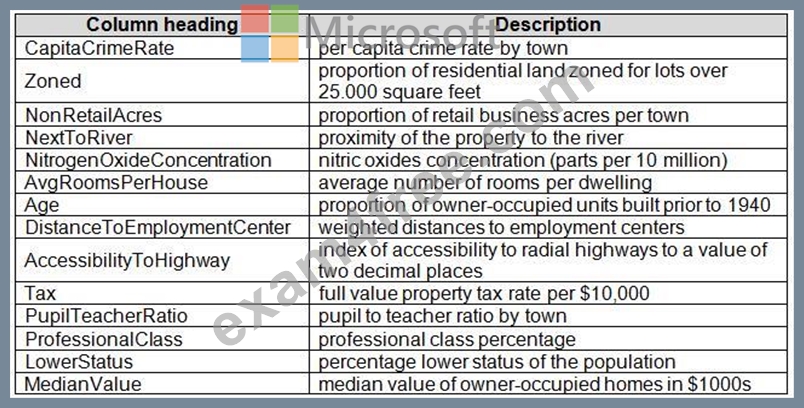
The two datasets have been added to Azure Machine Learning Studio as separate datasets and included as the starting point of the experiment.
Dataset issues
The AccessibilityToHighway column in both datasets contains missing values. The missing data must be replaced with new data so that it is modeled conditionally using the other variables in the data before filling in the missing values.
Columns in each dataset contain missing and null values. The dataset also contains many outliers. The Age column has a high proportion of outliers. You need to remove the rows that have outliers in the Age column.
The MedianValue and AvgRoomsinHouse columns both hold data in numeric format. You need to select a feature selection algorithm to analyze the relationship between the two columns in more detail.
Model fit
The model shows signs of overfitting. You need to produce a more refined regression model that reduces the overfitting.
Experiment requirements
You must set up the experiment to cross-validate the Linear Regression and Bayesian Linear Regression modules to evaluate performance.
In each case, the predictor of the dataset is the column named MedianValue. An initial investigation showed that the datasets are identical in structure apart from the MedianValue column. The smaller Paris dataset contains the MedianValue in text format, whereas the larger London dataset contains the MedianValue in numerical format. You must ensure that the datatype of the MedianValue column of the Paris dataset matches the structure of the London dataset.
You must prioritize the columns of data for predicting the outcome. You must use non-parameters statistics to measure the relationships.
You must use a feature selection algorithm to analyze the relationship between the MedianValue and AvgRoomsinHouse columns.
Model training
Given a trained model and a test dataset, you need to compute the permutation feature importance scores of feature variables. You need to set up the Permutation Feature Importance module to select the correct metric to investigate the model's accuracy and replicate the findings.
You want to configure hyperparameters in the model learning process to speed the learning phase by using hyperparameters. In addition, this configuration should cancel the lowest performing runs at each evaluation interval, thereby directing effort and resources towards models that are more likely to be successful.
You are concerned that the model might not efficiently use compute resources in hyperparameter tuning. You also are concerned that the model might prevent an increase in the overall tuning time. Therefore, you need to implement an early stopping criterion on models that provides savings without terminating promising jobs.
Testing
You must produce multiple partitions of a dataset based on sampling using the Partition and Sample module in Azure Machine Learning Studio. You must create three equal partitions for cross-validation. You must also configure the cross-validation process so that the rows in the test and training datasets are divided evenly by properties that are near each city's main river. The data that identifies that a property is near a river is held in the column named NextToRiver. You want to complete this task before the data goes through the sampling process.
When you train a Linear Regression module using a property dataset that shows data for property prices for a large city, you need to determine the best features to use in a model. You can choose standard metrics provided to measure performance before and after the feature importance process completes. You must ensure that the distribution of the features across multiple training models is consistent.
Data visualization
You need to provide the test results to the Fabrikam Residences team. You create data visualizations to aid in presenting the results.
You must produce a Receiver Operating Characteristic (ROC) curve to conduct a diagnostic test evaluation of the model. You need to select appropriate methods for producing the ROC curve in Azure Machine Learning Studio to compare the Two-Class Decision Forest and the Two-Class Decision Jungle modules with one another.
NEW QUESTION 55
You need to configure the Edit Metadata module so that the structure of the datasets match.
Which configuration options should you select? To answer, select the appropriate options in the answer area.
NOTE: Each correct selection is worth one point.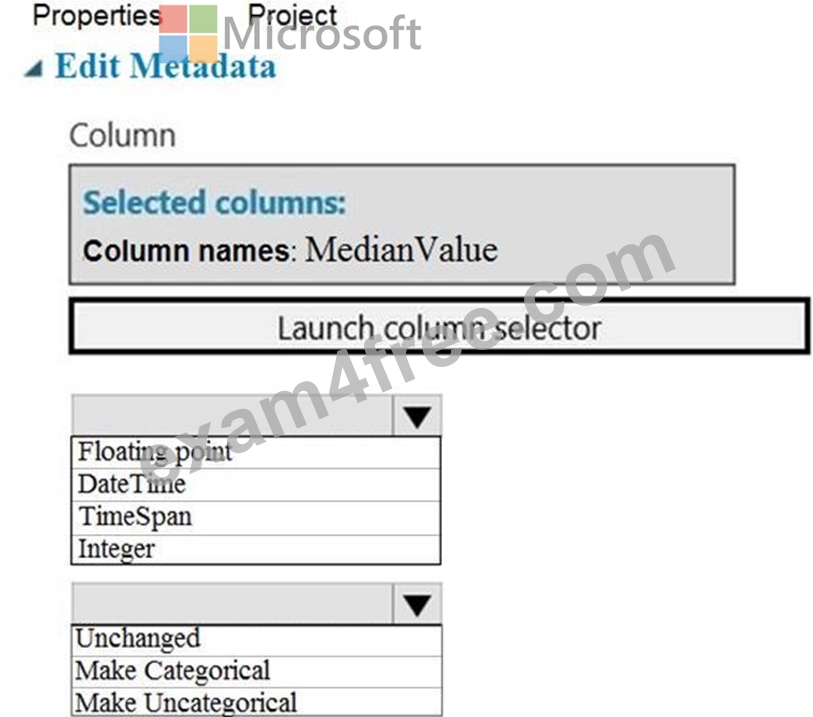
Answer:
Explanation:
Explanation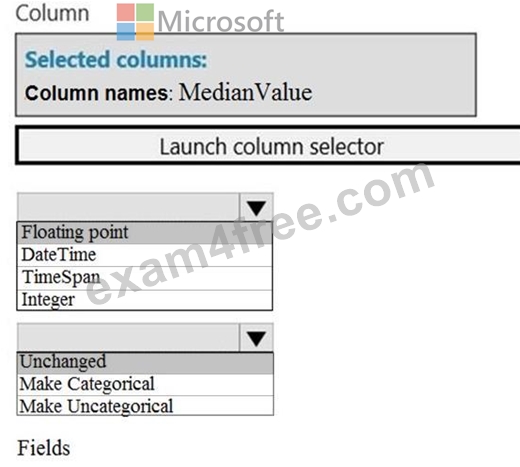
Box 1: Floating point
Need floating point for Median values.
Scenario: An initial investigation shows that the datasets are identical in structure apart from the MedianValue column. The smaller Paris dataset contains the MedianValue in text format, whereas the larger London dataset contains the MedianValue in numerical format.
Box 2: Unchanged
Note: Select the Categorical option to specify that the values in the selected columns should be treated as categories.
For example, you might have a column that contains the numbers 0,1 and 2, but know that the numbers actually mean "Smoker", "Non smoker" and "Unknown". In that case, by flagging the column as categorical you can ensure that the values are not used in numeric calculations, only to group data.
NEW QUESTION 56
You need to define a process for penalty event detection.
Which three actions should you perform in sequence? To answer, move the appropriate actions from the list of actions to the answer area and arrange them in the correct order.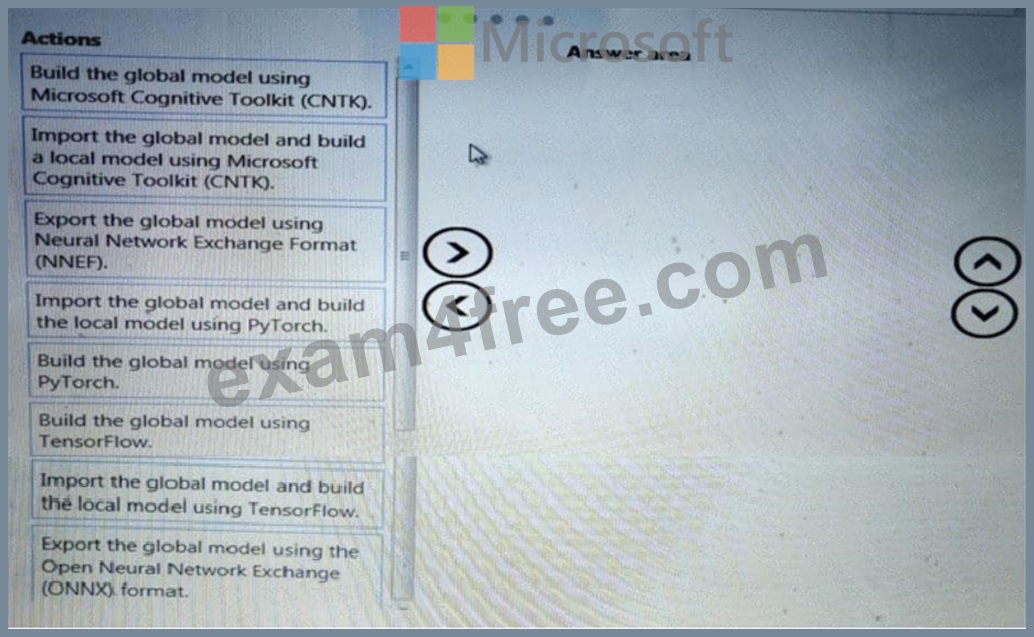
Answer:
Explanation: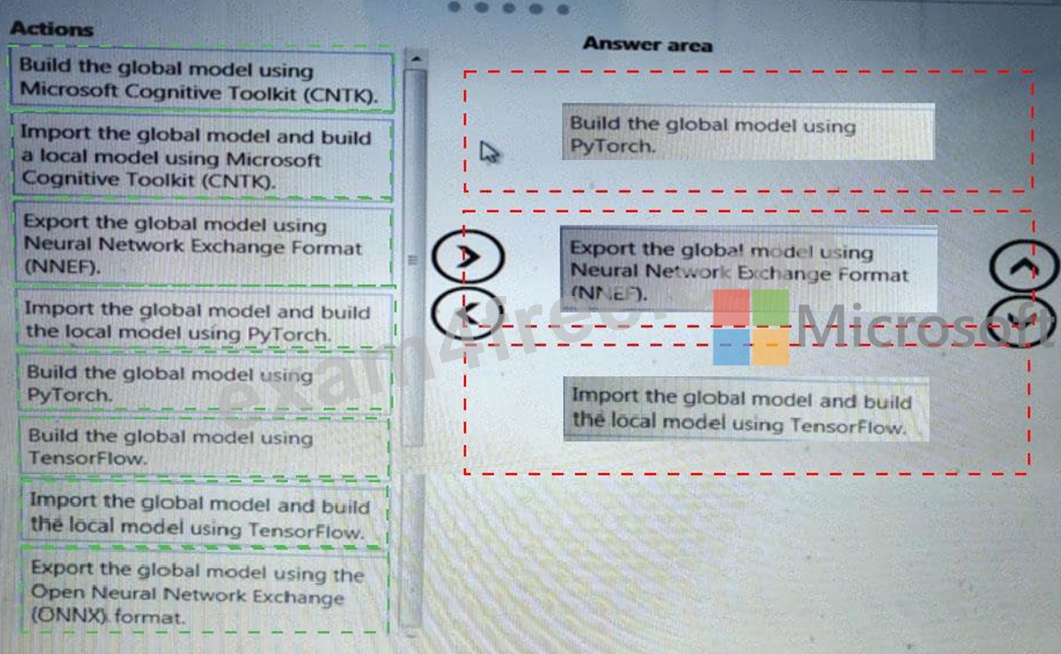
NEW QUESTION 57
You are developing a hands-on workshop to introduce Docker for Windows to attendees.
You need to ensure that workshop attendees can install Docker on their devices.
Which two prerequisite components should attendees install on the devices? Each correct answer presents part of the solution.
NOTE: Each correct selection is worth one point.
- A. Microsoft Hardware-Assisted Virtualization Detection Tool
- B. Windows 10 64-bit Professional
- C. VirtualBox
- D. Kitematic
- E. BIOS-enabled virtualization
Answer: B,E
Explanation:
C: Make sure your Windows system supports Hardware Virtualization Technology and that virtualization is enabled.
Ensure that hardware virtualization support is turned on in the BIOS settings. For example: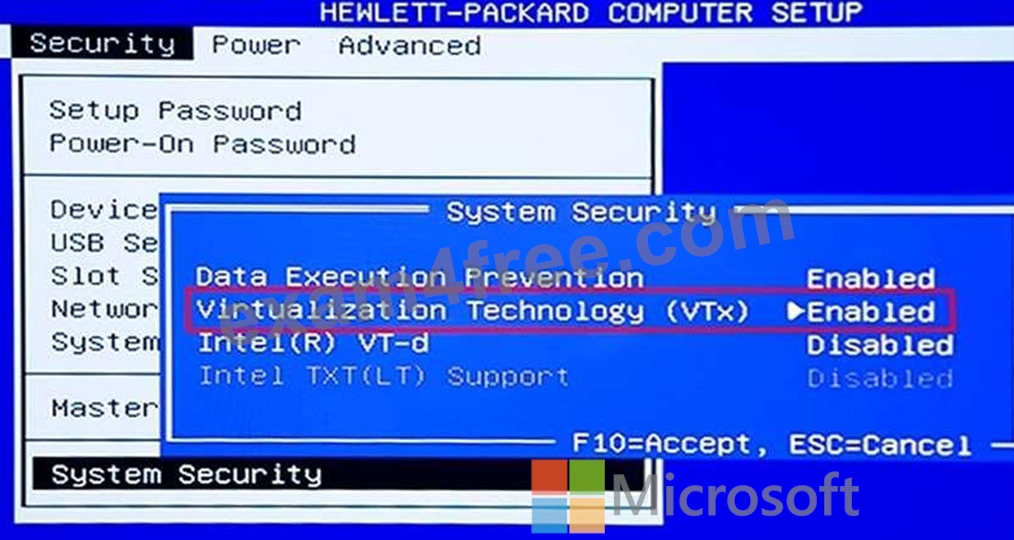
E: To run Docker, your machine must have a 64-bit operating system running Windows 7 or higher.
Reference:
https://docs.docker.com/toolbox/toolbox_install_windows/
https://blogs.technet.microsoft.com/canitpro/2015/09/08/step-by-step-enabling-hyper-v-for-use-on-windows-10/
NEW QUESTION 58
Note: This question is part of a series of questions that present the same scenario. Each question in the series contains a unique solution that might meet the stated goals. Some question sets might have more than one correct solution, while others might not have a correct solution.
After you answer a question in this section, you will NOT be able to return to it. As a result, these questions will not appear in the review screen.
You are using Azure Machine Learning Studio to perform feature engineering on a dataset.
You need to normalize values to produce a feature column grouped into bins.
Solution: Apply an Entropy Minimum Description Length (MDL) binning mode.
Does the solution meet the goal?
- A. Yes
- B. No
Answer: A
Explanation:
Explanation/Reference:
Explanation:
Entropy MDL binning mode: This method requires that you select the column you want to predict and the column or columns that you want to group into bins. It then makes a pass over the data and attempts to determine the number of bins that minimizes the entropy. In other words, it chooses a number of bins that allows the data column to best predict the target column. It then returns the bin number associated with each row of your data in a column named <colname>quantized.
References:
https://docs.microsoft.com/en-us/azure/machine-learning/studio-module-reference/group-data-into-bins
NEW QUESTION 59
You are using the Azure Machine Learning Service to automate hyper par a meter exploration of your neural network classification model.
You must define the hyper parameter space to automatically tune hyper parameters using random sampling according to following requirements:
* Learning rate must be selected from a normal distribution with a mean value of 10 and a standard deviation of 3.
* Batch size must be 16, 32 and 64.
* Keep probability must be a value selected from a uniform distribution between the range of 0.05 and 0.1.
You need to use the par am .sampling method of the Python API for the Azure Machine Learning Service.
How should you complete the code segment? To answer, select the appropriate Options in the answer area.
NOTE: Each correct selection is worth one point.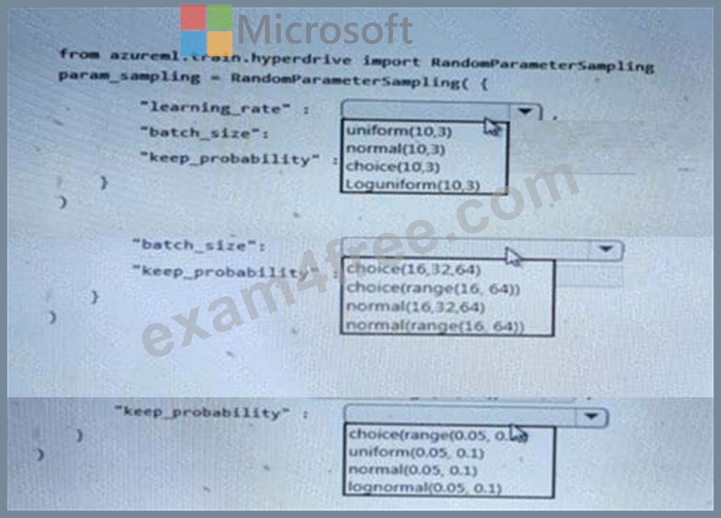
Answer:
Explanation: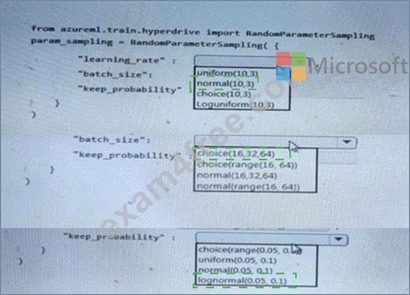
NEW QUESTION 60
You are a data scientist working for a hotel booking website company. You use the Azure Machine Learning service to train a model that identifies fraudulent transactions.
You must deploy the model as an Azure Machine Learning real-time web service using the Model.deploy method in the Azure Machine Learning SDK. The deployed web service must return real-time predictions of fraud based on transaction data input.
You need to create the script that is specified as the entry_script parameter for the InferenceConfig class used to deploy the model.
What should the entry script do?
- A. Start a node on the inference cluster where the web service is deployed.
- B. Register the model with appropriate tags and properties.
- C. Create a Conda environment for the web service compute and install the necessary Python packages.
- D. Load the model and use it to predict labels from input data.
- E. Specify the number of cores and the amount of memory required for the inference compute.
Answer: D
Explanation:
The entry script receives data submitted to a deployed web service and passes it to the model. It then takes the response returned by the model and returns that to the client. The script is specific to your model. It must understand the data that the model expects and returns.
The two things you need to accomplish in your entry script are:
Loading your model (using a function called init())
Running your model on input data (using a function called run())
Reference:
https://docs.microsoft.com/en-us/azure/machine-learning/how-to-deploy-and-where
NEW QUESTION 61
You are a data scientist working for a bank and have used Azure ML to train and register a machine learning model that predicts whether a customer is likely to repay a loan.
You want to understand how your model is making selections and must be sure that the model does not violate government regulations such as denying loans based on where an applicant lives.
You need to determine the extent to which each feature in the customer data is influencing predictions.
What should you do?
- A. Use the interpretability package to generate an explainer for the model.
- B. Add tags to the model registration indicating the names of the features in the training dataset.
- C. Score the model against some test data with known label values and use the results to calculate a confusion matrix.
- D. Enable data drift monitoring for the model and its training dataset.
- E. Use the Hyperdrive library to test the model with multiple hyperparameter values.
Answer: A
Explanation:
When you compute model explanations and visualize them, you're not limited to an existing model explanation for an automated ML model. You can also get an explanation for your model with different test data. The steps in this section show you how to compute and visualize engineered feature importance based on your test data.
Incorrect Answers:
A: In the context of machine learning, data drift is the change in model input data that leads to model performance degradation. It is one of the top reasons where model accuracy degrades over time, thus monitoring data drift helps detect model performance issues.
B: A confusion matrix is used to describe the performance of a classification model. Each row displays the instances of the true, or actual class in your dataset, and each column represents the instances of the class that was predicted by the model.
C: Hyperparameters are adjustable parameters you choose for model training that guide the training process. The HyperDrive package helps you automate choosing these parameters.
Reference:
https://docs.microsoft.com/en-us/azure/machine-learning/how-to-machine-learning-interpretability-automl
NEW QUESTION 62
You need to replace the missing data in the AccessibilityToHighway columns.
How should you configure the Clean Missing Data module? To answer, select the appropriate options in the answer area.
NOTE: Each correct selection is worth one point.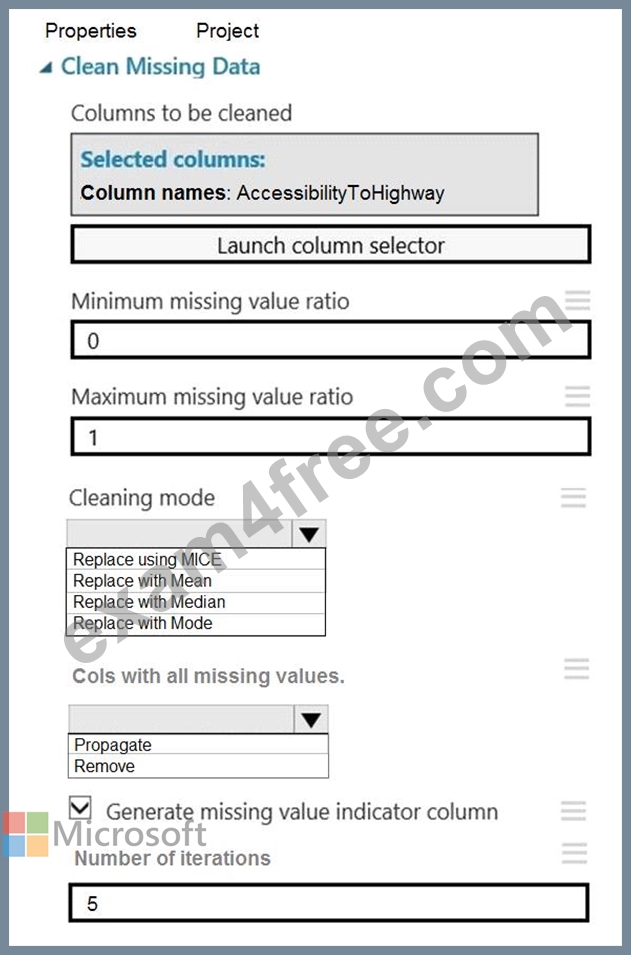
Answer:
Explanation: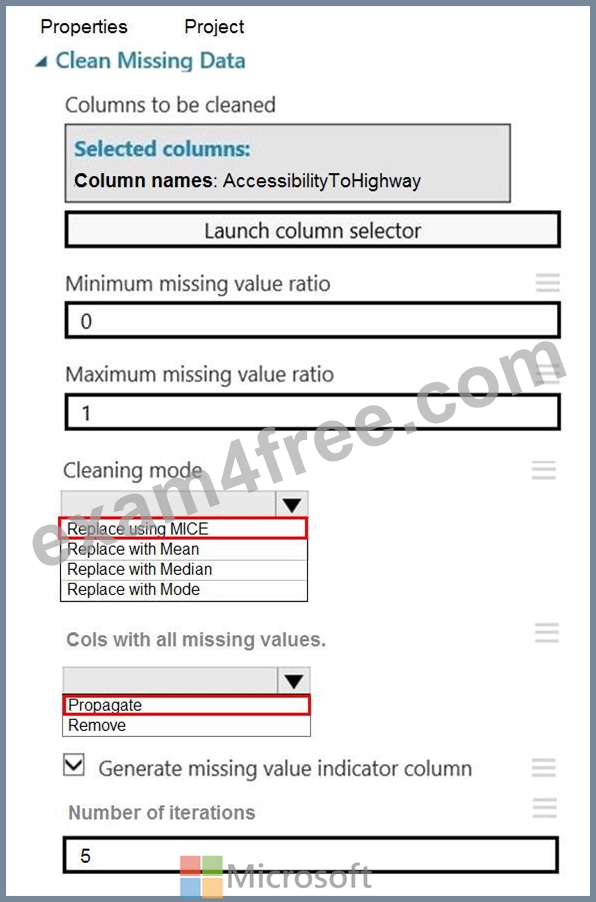
Explanation:
Box 1: Replace using MICE
Replace using MICE: For each missing value, this option assigns a new value, which is calculated by using a method described in the statistical literature as "Multivariate Imputation using Chained Equations" or "Multiple Imputation by Chained Equations". With a multiple imputation method, each variable with missing data is modeled conditionally using the other variables in the data before filling in the missing values.
Scenario: The AccessibilityToHighway column in both datasets contains missing values. The missing data must be replaced with new data so that it is modeled conditionally using the other variables in the data before filling in the missing values.
Box 2: Propagate
Cols with all missing values indicate if columns of all missing values should be preserved in the output.
References:
https://docs.microsoft.com/en-us/azure/machine-learning/studio-module-reference/clean-missing-data
NEW QUESTION 63
You are building a recurrent neural network to perform a binary classification.
You review the training loss, validation loss, training accuracy, and validation accuracy for each training epoch.
You need to analyze model performance.
You need to identify whether the classification model is overfitted.
Which of the following is correct?
- A. The training loss stays constant and the validation loss stays on a constant value and close to the training loss value when training the model.
- B. The training loss increases while the validation loss decreases when training the model.
- C. The training loss decreases while the validation loss increases when training the model.
- D. The training loss stays constant and the validation loss decreases when training the model.
Answer: C
Explanation:
An overfit model is one where performance on the train set is good and continues to improve, whereas performance on the validation set improves to a point and then begins to degrade.
References:
https://machinelearningmastery.com/diagnose-overfitting-underfitting-lstm-models/
NEW QUESTION 64
You are a lead data scientist for a project that tracks the health and migration of birds. You create a multi-image classification deep learning model that uses a set of labeled bird photos collected by experts. You plan to use the model to develop a cross-platform mobile app that predicts the species of bird captured by app users.
You must test and deploy the trained model as a web service. The deployed model must meet the following requirements:
* An authenticated connection must not be required for testing.
* The deployed model must perform with low latency during inferencing.
* The REST endpoints must be scalable and should have a capacity to handle large number of requests when multiple end users are using the mobile application.
You need to verify that the web service returns predictions in the expected JSON format when a valid REST request is submitted.
Which compute resources should you use? To answer, select the appropriate options in the answer area.
NOTE: Each correct selection is worth one point.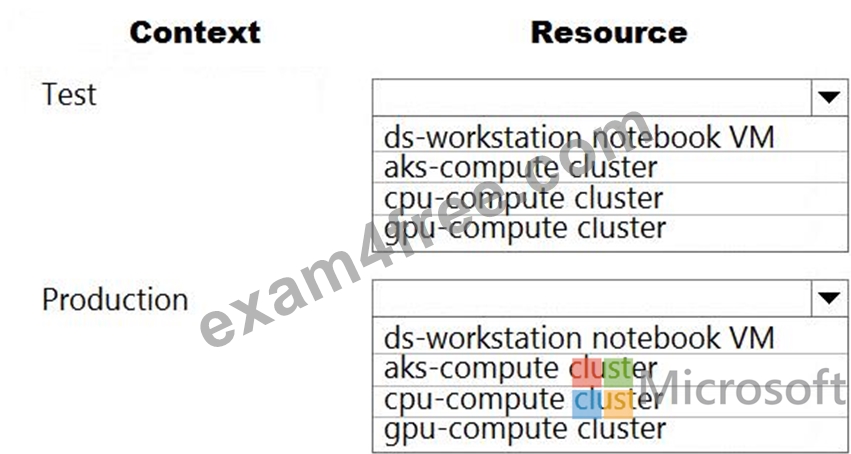
Answer:
Explanation: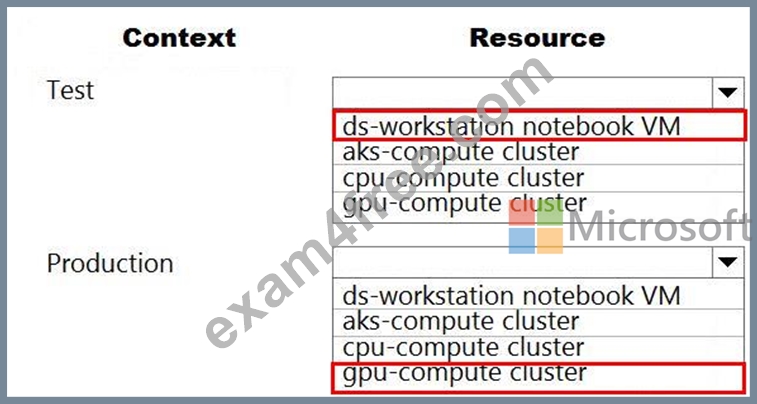
Explanation:
Box 1: ds-workstation notebook VM
An authenticated connection must not be required for testing.
On a Microsoft Azure virtual machine (VM), including a Data Science Virtual Machine (DSVM), you create local user accounts while provisioning the VM. Users then authenticate to the VM by using these credentials.
Box 2: gpu-compute cluster
Image classification is well suited for GPU compute clusters
Reference:
https://docs.microsoft.com/en-us/azure/machine-learning/data-science-virtual-machine/dsvm-common-identity
https://docs.microsoft.com/en-us/azure/architecture/reference-architectures/ai/training-deep-learning
NEW QUESTION 65
Note: This question is part of a series of questions that present the same scenario. Each question in the series contains a unique solution that might meet the stated goals. Some question sets might have more than one correct solution, while others might not have a correct solution.
After you answer a question in this section, you will NOT be able to return to it. As a result, these questions will not appear in the review screen.
You are analyzing a numerical dataset which contains missing values in several columns.
You must clean the missing values using an appropriate operation without affecting the dimensionality of the feature set.
You need to analyze a full dataset to include all values.
Solution: Use the Last Observation Carried Forward (LOCF) method to impute the missing data points.
Does the solution meet the goal?
- A. Yes
- B. No
Answer: B
Explanation:
Instead use the Multiple Imputation by Chained Equations (MICE) method.
Replace using MICE: For each missing value, this option assigns a new value, which is calculated by using a method described in the statistical literature as "Multivariate Imputation using Chained Equations" or "Multiple Imputation by Chained Equations". With a multiple imputation method, each variable with missing data is modeled conditionally using the other variables in the data before filling in the missing values.
Note: Last observation carried forward (LOCF) is a method of imputing missing data in longitudinal studies. If a person drops out of a study before it ends, then his or her last observed score on the dependent variable is used for all subsequent (i.e., missing) observation points. LOCF is used to maintain the sample size and to reduce the bias caused by the attrition of participants in a study.
References:
https://methods.sagepub.com/reference/encyc-of-research-design/n211.xml
https://www.ncbi.nlm.nih.gov/pmc/articles/PMC3074241/
NEW QUESTION 66
You need to identify the methods for dividing the data according to the testing requirements.
Which properties should you select? To answer, select the appropriate options in the answer area.
NOTE: Each correct selection is worth one point.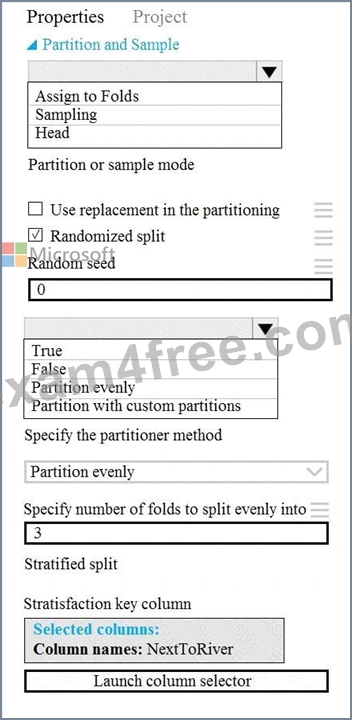
Answer:
Explanation: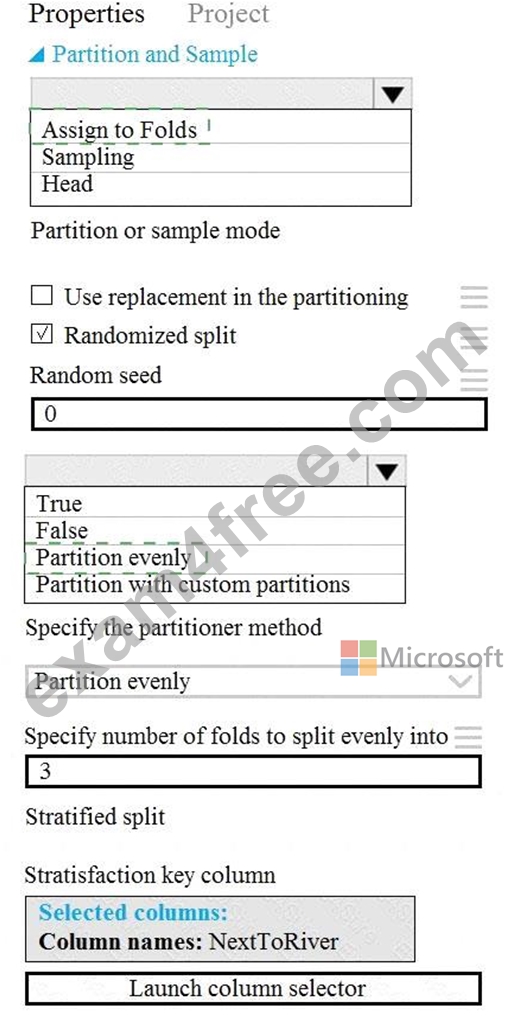
Explanation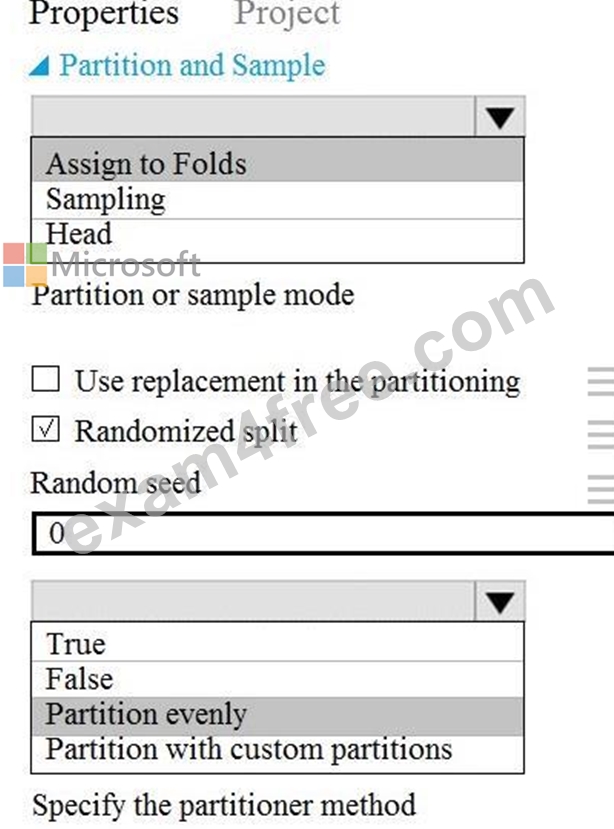
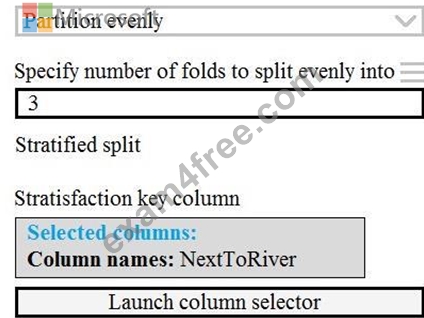
Scenario: Testing
You must produce multiple partitions of a dataset based on sampling using the Partition and Sample module in Azure Machine Learning Studio.
Box 1: Assign to folds
Use Assign to folds option when you want to divide the dataset into subsets of the data. This option is also useful when you want to create a custom number of folds for cross-validation, or to split rows into several groups.
Not Head: Use Head mode to get only the first n rows. This option is useful if you want to test a pipeline on a small number of rows, and don't need the data to be balanced or sampled in any way.
Not Sampling: The Sampling option supports simple random sampling or stratified random sampling. This is useful if you want to create a smaller representative sample dataset for testing.
Box 2: Partition evenly
Specify the partitioner method: Indicate how you want data to be apportioned to each partition, using these options:
* Partition evenly: Use this option to place an equal number of rows in each partition. To specify the number of output partitions, type a whole number in the Specify number of folds to split evenly into text box.
Reference:
https://docs.microsoft.com/en-us/azure/machine-learning/algorithm-module-reference/partition-and-sample
NEW QUESTION 67
You need to implement a scaling strategy for the local penalty detection data.
Which normalization type should you use?
- A. Weight
- B. Batch
- C. Cosine
- D. Streaming
Answer: B
Explanation:
Post batch normalization statistics (PBN) is the Microsoft Cognitive Toolkit (CNTK) version of how to evaluate the population mean and variance of Batch Normalization which could be used in inference Original Paper.
In CNTK, custom networks are defined using the BrainScriptNetworkBuilder and described in the CNTK network description language "BrainScript." Scenario:
Local penalty detection models must be written by using BrainScript.
References:
https://docs.microsoft.com/en-us/cognitive-toolkit/post-batch-normalization-statistics Prepare data for modeling Testlet 2 Case study This is a case study. Case studies are not timed separately. You can use as much exam time as you would like to complete each case. However, there may be additional case studies and sections on this exam. You must manage your time to ensure that you are able to complete all questions included on this exam in the time provided.
To answer the questions included in a case study, you will need to reference information that is provided in the case study. Case studies might contain exhibits and other resources that provide more information about the scenario that is described in the case study. Each question is independent of the other questions in this case study.
At the end of this case study, a review screen will appear. This screen allows you to review your answers and to make changes before you move to the next section of the exam. After you begin a new section, you cannot return to this section.
To start the case study
To display the first question in this case study, click the Next button. Use the buttons in the left pane to explore the content of the case study before you answer the questions. Clicking these buttons displays information such as business requirements, existing environment, and problem statements. If the case study has an All Information tab, note that the information displayed is identical to the information displayed on the subsequent tabs. When you are ready to answer a question, click the Question button to return to the question.
Overview
You are a data scientist for Fabrikam Residences, a company specializing in quality private and commercial property in the Unites States. Fabrikam Residences is considering expanding into Europe and has asked you to investigate prices for private residences in major European cities.
You use Azure Machine Learning Studio to measure the median value of properties. You produce a regression model to predict property prices by using the Linear Regression and Bayesian Linear Regression modules.
Datasets
There are two datasets in CSV format that contain property details for two cities, London and Paris. You add both files to Azure Machine Learning Studio as separate datasets to the starting point for an experiment. Both datasets contain the following columns: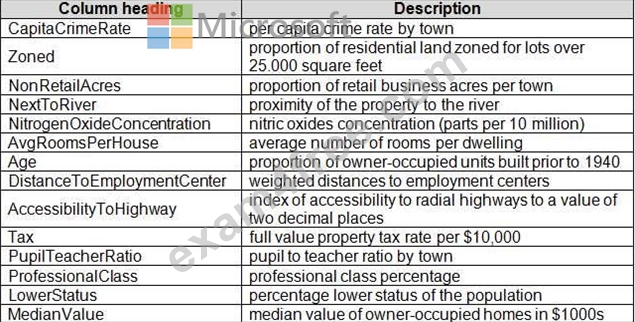
An initial investigation shows that the datasets are identical in structure apart from the MedianValue column.
The smaller Paris dataset contains the MedianValue in text format, whereas the larger London dataset contains the MedianValue in numerical format.
Data issues
Missing values
The AccessibilityToHighway column in both datasets contains missing values. The missing data must be replaced with new data so that it is modeled conditionally using the other variables in the data before filling in the missing values.
Columns in each dataset contain missing and null values. The datasets also contain many outliers. The Age column has a high proportion of outliers. You need to remove the rows that have outliers in the Age column.
The MedianValue and AvgRoomsInHouse columns both hold data in numeric format. You need to select a feature selection algorithm to analyze the relationship between the two columns in more detail.
Model fit
The model shows signs of overfitting. You need to produce a more refined regression model that reduces the overfitting.
Experiment requirements
You must set up the experiment to cross-validate the Linear Regression and Bayesian Linear Regression modules to evaluate performance. In each case, the predictor of the dataset is the column named MedianValue. You must ensure that the datatype of the MedianValue column of the Paris dataset matches the structure of the London dataset.
You must prioritize the columns of data for predicting the outcome. You must use non-parametric statistics to measure relationships.
You must a feature selection algorithm to analyze the relationship between the MediaValue and AvgRoomsinHouse columns.
Model training
Permutation Feature Importance
Given a trained model and a test dataset, you must compute the Permutation Feature Importance scores of feature variables. You must be determined the absolute fit for the model.
Hyperparameters
You must configure hyperparameters in the model learning process to speed the learning phase. In addition, this configuration should cancel the lowest performing runs at each evaluation interval, thereby directing effort and resources towards models that are more likely to be successful.
You are concerned that the model might not efficiently use compute resources in hyperparameter tuning. You also are concerned that the model might prevent an increase in the overall tuning time. Therefore, must implement an early stopping criterion on models that provides savings without terminating promising jobs.
Testing
You must produce multiple partitions of a dataset based on sampling using the Partition and Sample module in Azure Machine Learning Studio.
Cross-validation
You must create three equal partitions for cross-validation. You must also configure the cross-validation process so that the rows in the test and training datasets are divided evenly by properties that are near each city's main river. You must complete this task before the data goes through the sampling process.
Linear regression module
When you train a Linear Regression module, you must determine the best features to use in a model. You can choose standard metrics provided to measure performance before and after the feature importance process completes. The distribution of features across multiple training models must be consistent.
Data visualization
You need to provide the test results to the Fabrikam Residences team. You create data visualizations to aid in presenting the results.
You must produce a Receiver Operating Characteristic (ROC) curve to conduct a diagnostic test evaluation of the model. You need to select appropriate methods for producing the ROC curve in Azure Learning Studio to compare the Two-Class Decision Forest and the Two-Class Decision Jungle modules with one another.
NEW QUESTION 68
You have a Python data frame named salesData in the following format:
The data frame must be unpivoted to a long data format as follows:
You need to use the pandas.melt() function in Python to perform the transformation.
How should you complete the code segment? To answer, select the appropriate options in the answer area.
NOTE: Each correct selection is worth one point.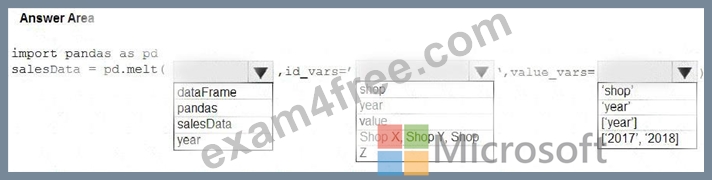
Answer:
Explanation: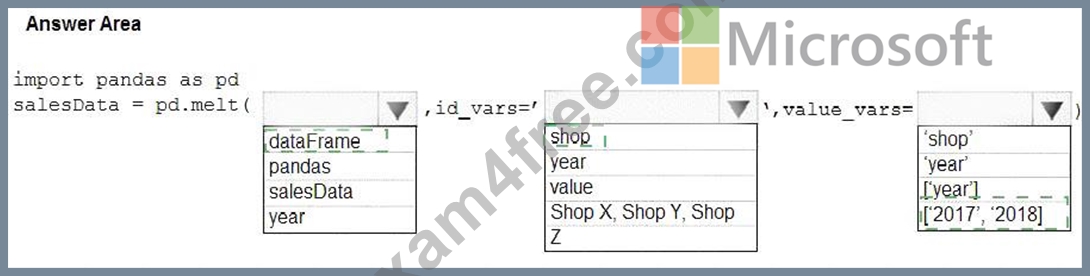
Explanation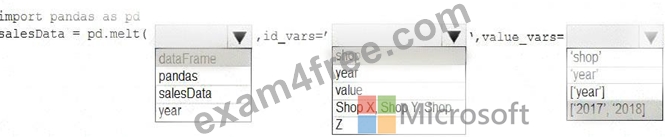
Box 1: dataFrame
Syntax: pandas.melt(frame, id_vars=None, value_vars=None, var_name=None, value_name='value', col_level=None)[source] Where frame is a DataFrame Box 2: shop Paramter id_vars id_vars : tuple, list, or ndarray, optional Column(s) to use as identifier variables.
Box 3: ['2017','2018']
value_vars : tuple, list, or ndarray, optional
Column(s) to unpivot. If not specified, uses all columns that are not set as id_vars.
Example:
df = pd.DataFrame({'A': {0: 'a', 1: 'b', 2: 'c'},
'B': {0: 1, 1: 3, 2: 5},
'C': {0: 2, 1: 4, 2: 6}})
pd.melt(df, id_vars=['A'], value_vars=['B', 'C'])
A variable value
0 a B 1
1 b B 3
2 c B 5
3 a C 2
4 b C 4
5 c C 6
References:
https://pandas.pydata.org/pandas-docs/stable/reference/api/pandas.melt.html
NEW QUESTION 69
You are creating an experiment by using Azure Machine Learning Studio.
You must divide the data into four subsets for evaluation. There is a high degree of missing values in the dat a. You must prepare the data for analysis.
You need to select appropriate methods for producing the experiment.
Which three modules should you run in sequence? To answer, move the appropriate actions from the list of actions to the answer area and arrange them in the correct order.
NOTE: More than one order of answer choices is correct. You will receive credit for any of the correct orders you select.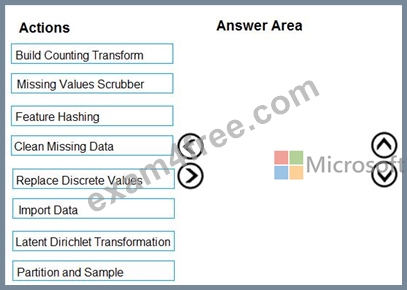
Answer:
Explanation: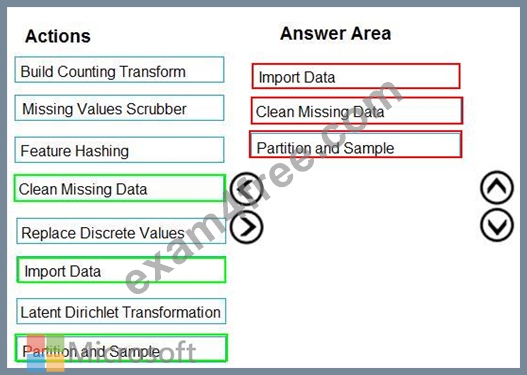
Explanation:
The Clean Missing Data module in Azure Machine Learning Studio, to remove, replace, or infer missing values.
Incorrect Answers:
Latent Direchlet Transformation: Latent Dirichlet Allocation module in Azure Machine Learning Studio, to group otherwise unclassified text into a number of categories. Latent Dirichlet Allocation (LDA) is often used in natural language processing (NLP) to find texts that are similar. Another common term is topic modeling.
Build Counting Transform: Build Counting Transform module in Azure Machine Learning Studio, to analyze training data. From this data, the module builds a count table as well as a set of count-based features that can be used in a predictive model.
Missing Value Scrubber: The Missing Values Scrubber module is deprecated.
Feature hashing: Feature hashing is used for linguistics, and works by converting unique tokens into integers.
Replace discrete values: the Replace Discrete Values module in Azure Machine Learning Studio is used to generate a probability score that can be used to represent a discrete value. This score can be useful for understanding the information value of the discrete values.
References:
https://docs.microsoft.com/en-us/azure/machine-learning/studio-module-reference/clean-missing-data
NEW QUESTION 70
You create an experiment in Azure Machine Learning Studio- You add a training dataset that contains 10.000 rows. The first 9.000 rows represent class 0 (90 percent). The first 1.000 rows represent class 1 (10 percent).
The training set is unbalanced between two Classes. You must increase the number of training examples for class 1 to 4,000 by using data rows. You add the Synthetic Minority Oversampling Technique (SMOTE) module to the experiment.
You need to configure the module.
Which values should you use? To answer, select the appropriate options in the dialog box in the answer area.
NOTE: Each correct selection is worth one point.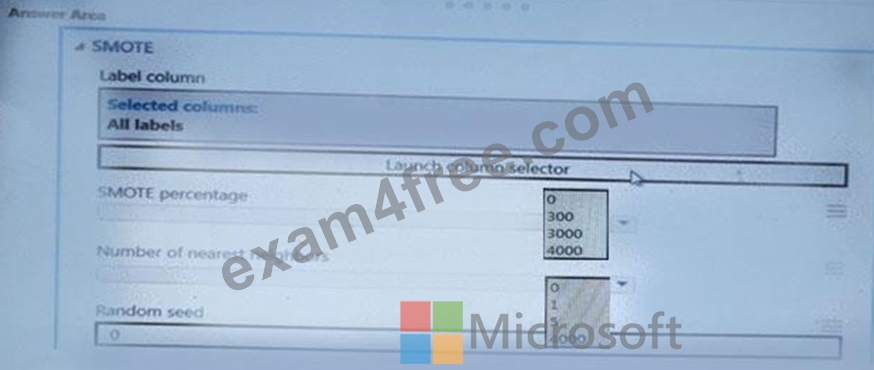
Answer:
Explanation: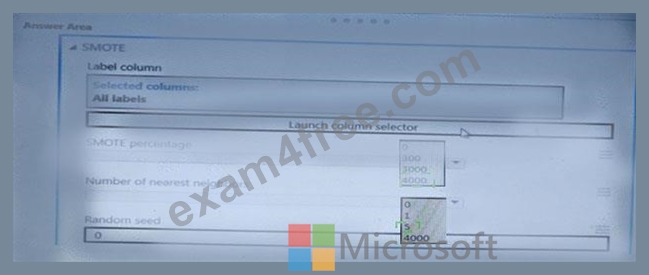
NEW QUESTION 71
You plan to run a script as an experiment using a Script Run Configuration. The script uses modules from the scipy library as well as several Python packages that are not typically installed in a default conda environment You plan to run the experiment on your local workstation for small datasets and scale out the experiment by running it on more powerful remote compute clusters for larger datasets.
You need to ensure that the experiment runs successfully on local and remote compute with the least administrative effort.
What should you do?
- A. Create a virtual machine (VM) with the required Python configuration and attach the VM as a compute target. Use this compute target for all experiment runs.
- B. Do not specify an environment in the run configuration for the experiment. Run the experiment by using the default environment.
- C. Create and register an Environment that includes the required packages. Use this Environment for all experiment runs.
- D. Always run the experiment with an Estimator by using the default packages.
- E. Create a config.yaml file defining the conda packages that are required and save the file in the experiment folder.
Answer: C
Explanation:
Explanation
If you have an existing Conda environment on your local computer, then you can use the service to create an environment object. By using this strategy, you can reuse your local interactive environment on remote runs.
Reference:
https://docs.microsoft.com/en-us/azure/machine-learning/how-to-use-environments
NEW QUESTION 72
You need to visually identify whether outliers exist in the Age column and quantify the outliers before the outliers are removed.
Which three Azure Machine Learning Studio modules should you use in sequence? To answer, move the appropriate modules from the list of modules to the answer area and arrange them in the correct order.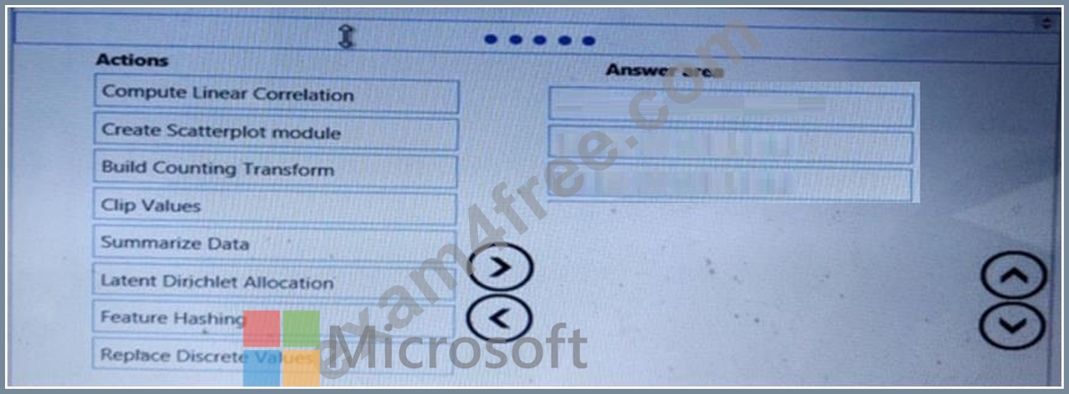
Answer:
Explanation: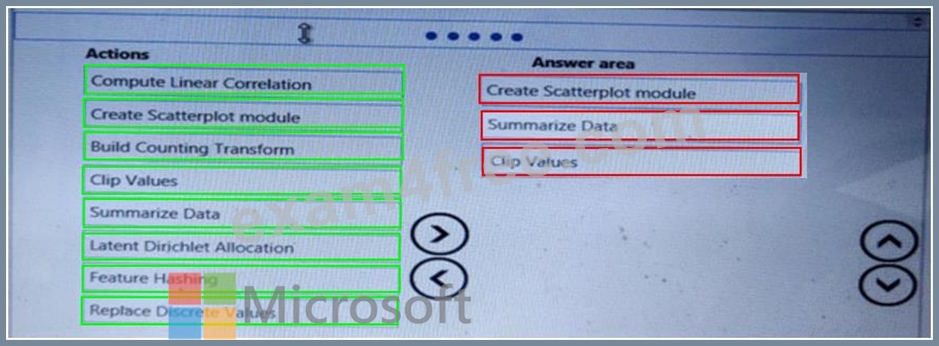
Explanation:
You can use the Clip Values module in Azure Machine Learning Studio, to identify and optionally replace data values that are above or below a specified threshold. This is useful when you want to remove outliers or replace them with a mean, a constant, or other substitute value.
References:
https://blogs.msdn.microsoft.com/azuredev/2017/05/27/data-cleansing-tools-in-azure-machine-learning/
https://docs.microsoft.com/en-us/azure/machine-learning/studio-module-reference/clip-values
NEW QUESTION 73
Note: This question is part of a series of questions that present the same scenario. Each question in the series contains a unique solution that might meet the stated goals. Some question sets might have more than one correct solution, while others might not have a correct solution.
After you answer a question in this section, you will NOT be able to return to it. As a result, these questions will not appear in the review screen.
You are creating a new experiment in Azure Machine Learning Studio.
One class has a much smaller number of observations than the other classes in the training set.
You need to select an appropriate data sampling strategy to compensate for the class imbalance.
Solution: You use the Synthetic Minority Oversampling Technique (SMOTE) sampling mode.
Does the solution meet the goal?
- A. Yes
- B. No
Answer: A
Explanation:
SMOTE is used to increase the number of underepresented cases in a dataset used for machine learning.
SMOTE is a better way of increasing the number of rare cases than simply duplicating existing cases.
References:
https://docs.microsoft.com/en-us/azure/machine-learning/studio-module-reference/smote
NEW QUESTION 74
......
Career Opportunities & Salary Outlook
The demand for the certified professionals is on the increase. As an Azure Data Scientist, you can explore many employment opportunities. So, if you want to boost your career potential, pursuing the Microsoft Certified: Azure Data Scientist Associate certification is the right step. To get this certificate, you have to pass the qualifying exam, which is Microsoft DP-100. With this associate-level certification, you can get the positions, such as a Data Scientist, a Senior Data Scientist, a Data Science Manager, and a Data Science Director. The average salary for these job roles is $135,000 per annum. With advanced experience, the specialists can earn up to $170,000 per year.
Realistic Exam4Free DP-100 Dumps PDF - 100% Passing Guarantee: https://torrentvce.exam4free.com/DP-100-valid-dumps.html
