
XK0-005 Exam Dumps - Try Best XK0-005 Exam Questions from Training Expert Exam4Free
Practice Examples and Dumps & Tips for 2025 Latest XK0-005 Valid Tests Dumps
CompTIA XK0-005 exam is a valuable certification for IT professionals seeking to validate their skills and knowledge in Linux systems. CompTIA Linux+ Certification Exam certification is vendor-neutral and covers various Linux distributions, making it ideal for professionals working with different Linux-based technologies. With the CompTIA Linux+ certification, candidates can expand their career opportunities and demonstrate their expertise in managing, configuring, and troubleshooting Linux systems.
CompTIA XK0-005 certification is a valuable credential for Linux system administrators. CompTIA Linux+ Certification Exam certification validates the skills and knowledge required for a Linux system administrator, and it is recognized by industry professionals worldwide. CompTIA Linux+ Certification Exam certification offers many benefits, including better job prospects, higher salary, and career advancement. With this certification, Linux system administrators can demonstrate their skills and knowledge to employers, clients, and colleagues.
NEW QUESTION # 12
A Linux systems administrator installed a new web server, which failed while attempting to start.
The administrator suspects that SELinux is causing an issue and wants to temporarily put the system into permissive mode. Which of the following would allow the administrator to accomplish this?
- A. chcon httpd_sys_content_t /var/
- B. setenforce 0
- C. echo SELINUX=PERMISSIVE >> /etc/sysconfig/selinux
- D. sestatus 0
Answer: B
Explanation:
In sudo setenforce 0, you can use permissive instead of 0. This command changes SELinux mode from targeted to permissive. In permissive mode, the service is active and audits all actions. However, it does not enforce any security policies.
NEW QUESTION # 13
A systems administrator needs to run the yum update command two hours after employees log off and leave for the day on Friday.
Which of the following is the BEST command to complete the task, if the task only needs to be run once?
- A. screen
- B. at
- C. nohup
- D. cron
Answer: B
Explanation:
nohup Run the named command with its optional command arguments, continuing to run it even after you log out (make command immune to hangups-i.e., no hangup), since the admin wants to run the job after 2 hours, it would be easier to cron the job with AT.
AT:
at is a command-line utility that allows you to schedule commands to be executed at a particular time. Jobs created with at are executed only once. In this article, we will explain how to use at and its companion utilities batch, atq, atrm to view, delete, and create jobs to be executed at a later time.
NEW QUESTION # 14
A Linux administrator is troubleshooting the root cause of a high CPU load and average.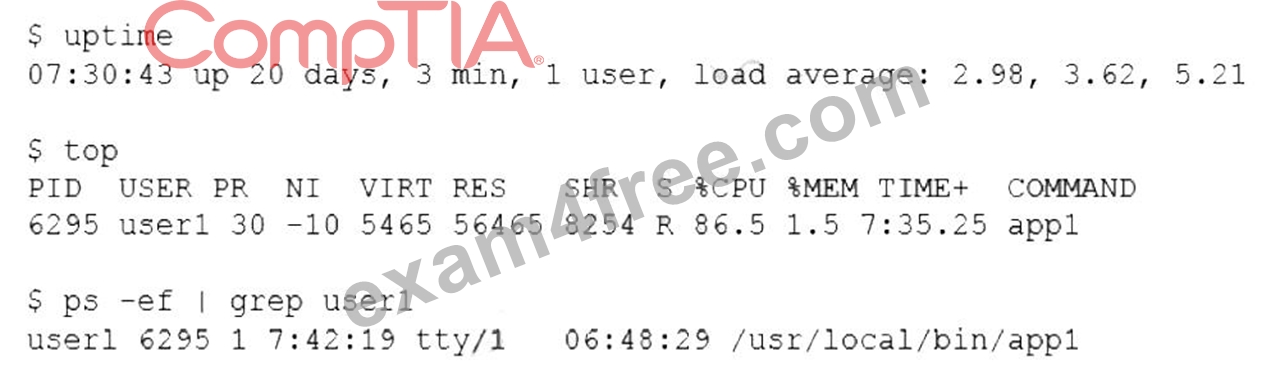
Which of the following commands will permanently resolve the issue?
- A. renice -n -20 6295
- B. pstree -p 6295
- C. iostat -cy 1 5
- D. kill -9 6295
Answer: A
NEW QUESTION # 15
A systems administrator receives reports that several virtual machines in a host are responding slower than expected. Upon further investigation, the administrator obtains the following output from one of the affected systems:
Which of the following best explains the reported issue?
- A. The physical host is running out of CPU resources, leading to insufficient CPU time being allocated to virtual machines.
- B. The virtual machine has enough CPU cycles, leading to the system use percentage being higher than expected.
- C. The physical host has enough CPU cores, leading to users running more processes to compensate for the slower response times.
- D. The virtual machine is running out of CPU resources, leading to users experiencing longer response times.
Answer: D
Explanation:
Explanation
Based on the output from one of the affected systems, the best explanation for the reported issue is that the virtual machine is running out of CPU resources, leading to users experiencing longer response times (D). The output shows that the system use percentage is very high (57.85%), indicating that the virtual machine is using most of its CPU cycles for system processes. This leaves little CPU time for user processes, which results in slower performance. The other explanations are not supported by the output or are contradictory. References:
[CompTIA Linux+ Study Guide], Chapter 8: Optimizing Linux Performance, Section: Monitoring CPU Usage
[How to Interpret CPU Usage Statistics]
NEW QUESTION # 16
An administrator created an initial Git repository and uploaded the first files. The administrator sees the following when listing the repository: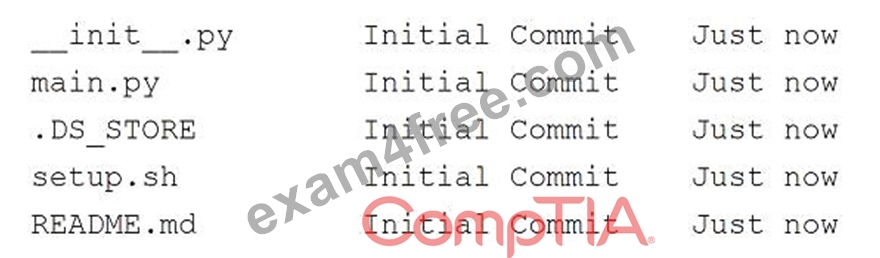
The administrator notices the file . DS STORE should not be included and deletes it from the online repository. Which of the following should the administrator run from the root of the local repository before the next commit to ensure the file is not uploaded again in future commits?
- A. rm -f .DS STORE && git push
- B. git fetch && git checkout .DS STORE
- C. echo .DS STORE >> .gitignore
- D. rm -f .DS STORE && git rebase origin main
Answer: C
Explanation:
Explanation
The correct answer is D. The administrator should run "echo .DS STORE >> .gitignore" from the root of the local repository before the next commit to ensure the file is not uploaded again in future commits.
This command will append the file name .DS STORE to the end of the .gitignore file, which is a special file that tells Git to ignore certain files or directories that should not be tracked or uploaded to the repository. By adding .DS STORE to the .gitignore file, the administrator will prevent Git from staging, committing, or pushing this file in the future.
The other options are incorrect because:
A: rm -f .DS STORE && git push
This command will delete the file .DS STORE from the local repository and then push the changes to the remote repository. However, this does not prevent the file from being uploaded again in future commits, if it is recreated or copied to the local repository.
B: git fetch && git checkout .DS STORE
This command will fetch the latest changes from the remote repository and then restore the file .DS STORE from the remote repository to the local repository. This is not what the administrator wants to do, as this will undo the deletion of the file from the online repository.
C: rm -f .DS STORE && git rebase origin main
This command will delete the file .DS STORE from the local repository and then rebase the local branch onto the main branch of the remote repository. This will rewrite the commit history of the local branch and may cause conflicts or errors. This is not what the administrator wants to do, as this is a risky and unnecessary operation.
NEW QUESTION # 17
Users are unable to connect to a server using HTTPS. The administrator runs the following command on the remote system: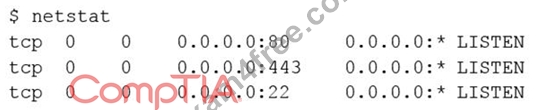
Then, the administrator runs the following command from a local workstation: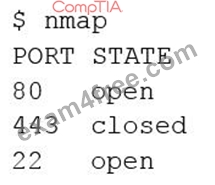
Which of the following steps should the administrator take to address the issue?
- A. Update the self-signed certificate
- B. Start the application to run on port 443
- C. Allow port 443 through the firewall
- D. Configure the application to run on an active port
Answer: C
Explanation:
The port 443 HTTPS is blocked by the firewall so answer is Allow port 443 through the firewall.
NEW QUESTION # 18
A Linux systems administrator receives reports from various users that an application hosted on a server has stopped responding at similar times for several days in a row. The administrator logs in to the system and obtains the following output:
Output 1:
Output 2:
Output 3:
Which of the following should the administrator do to provide the BEST solution for the reported issue?
- A. Configure memory allocation policies during business hours and prevent the Java process from going into a zombie state while the server is idle.
- B. Configure the swap space to allow for spikes in usage during peak hours and prevent the Java process from stopping due to a lack of memory.
- C. Configure a different nice value for the Java process to allow for more users and prevent the Java process from restarting during business hours.
- D. Configure more CPU cores to allow for the server to allocate more processing and prevent the Java process from consuming all of the available resources.
Answer: B
Explanation:
Explanation
Based on the output of the image sent by the user, the system requires more swap space to allow for spikes in usage during peak hours and prevent the Java process from stopping due to a lack of memory. The output shows that there is only 0 MB of swap space available on the system, which means that there is no room for swapping out memory pages when physical memory is full or low. The output also shows that there is only
793 MB of available memory on the system, which may not be enough to handle high-demand applications such as Java. This may cause Java to stop working due to insufficient memory or trigger an OutOfMemoryError exception. Configuring more swap space on the system would help to alleviate this issue by providing more virtual memory for applications and improving performance. Configuring memory allocation policies during business hours will not help to solve this issue, as it will not increase the amount of available memory or swap space on the system. Configuring a different nice value for Java process will not help to solve this issue, as it will only affect its scheduling priority, not its memory consumption or allocation.
Configuring more CPU cores will not help to solve this issue, as it will only increase processing power, not memory capacity or availability. References: CompTIA Linux+ (XK0-005) Certification Study Guide, Chapter
15: Managing Memory and Process Execution, page 468.
NEW QUESTION # 19
A systems administrator detected corruption in the /data filesystem. Given the following output: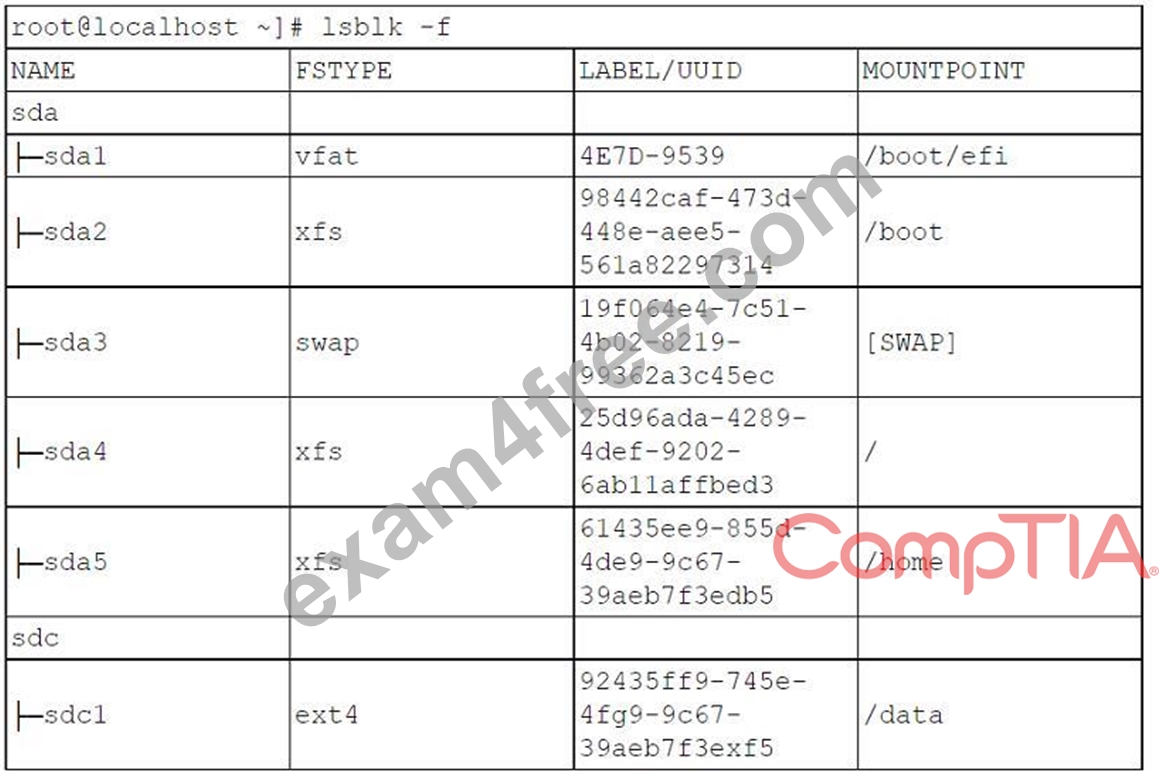
Which of the following commands can the administrator use to best address this issue?
- A. umount /data
pvs /dev/sdcl
mount /data - B. umount /data
mkfs . xfs /dev/sclcl
mount /data - C. umount /data
xfs repair /dev/ sdcl
mount /data - D. umount /data
fsck /dev/ sdcl
mount / data
Answer: C
Explanation:
The xfs repair command is used to check and repair an XFS filesystem, which is the type of filesystem used for the /data partition, as shown in the output. The administrator needs to unmount the /data partition before running the xfs repair command on it, and then mount it back after the repair is done. For example: umount
/data; xfs_repair /dev/sdcl; mount /data. The mkfs.xfs command is used to create a new XFS filesystem, which would erase all the data on the partition. The fsck command is used to check and repair other types of filesystems, such as ext4, but not XFS. The pvs command is used to display information about physical volumes in a logical volume manager (LVM) setup, which is not relevant for this issue.
NEW QUESTION # 20
A Linux administrator has set up a new DNS forwarder and is configuring all internal servers to use the new forwarder to look up external DNS requests. The administrator needs to modify the firewall on the server for the DNS forwarder to allow the internal servers to communicate to it and make the changes persistent between server reboots. Which of the following commands should be run on the DNS forwarder server to accomplish this task?
- A. iptables -A OUTPUT -p udp -ra udp -dport 53 -j ACCEPT
- B. flrewall-cmd --zone-public --add-port-53/udp --permanent
- C. ufw allow out dns
- D. systemctl reload firewalld
Answer: B
Explanation:
The command that should be run on the DNS forwarder server to accomplish the task is firewall-cmd --zone=public --add-port=53/udp --permanent. The firewall-cmd command is a tool for managing firewalld, which is a firewall service that provides dynamic and persistent network security on Linux systems. The firewalld uses zones and services to define the rules and policies for the network traffic. The zones are logical groups of network interfaces and sources that have the same level of trust and security. The services are predefined sets of ports and protocols that are associated with certain applications or functions. The --zone=public option specifies the zone name that the rule applies to. The public zone is the default zone that represents the untrusted network, such as the internet. The --add-port=53/udp option adds a port and protocol to the zone. The 53 is the port number that is used by the DNS service. The udp is the protocol that is used by the DNS service. The --permanent option makes the change persistent across reboots. The command firewall-cmd --zone=public --add-port=53/udp --permanent will modify the firewall on the server for the DNS forwarder to allow the internal servers to communicate to it and make the changes persistent between server reboots. This is the correct command to use to accomplish the task. The other options are incorrect because they either do not modify the firewall on the server for the DNS forwarder (ufw allow out dns or systemctl reload firewalld) or do not use the correct syntax for the command (iptables -A OUTPUT -p udp -ra udp -dport 53 -j ACCEPT instead of iptables -A OUTPUT -p udp -ra udp --dport 53 -j ACCEPT). Reference: CompTIA Linux+ (XK0-005) Certification Study Guide, Chapter 12: Managing Network Connections, page 392.
NEW QUESTION # 21
A systems administrator is deploying three identical, cloud-based servers. The administrator is using the following code to complete the task: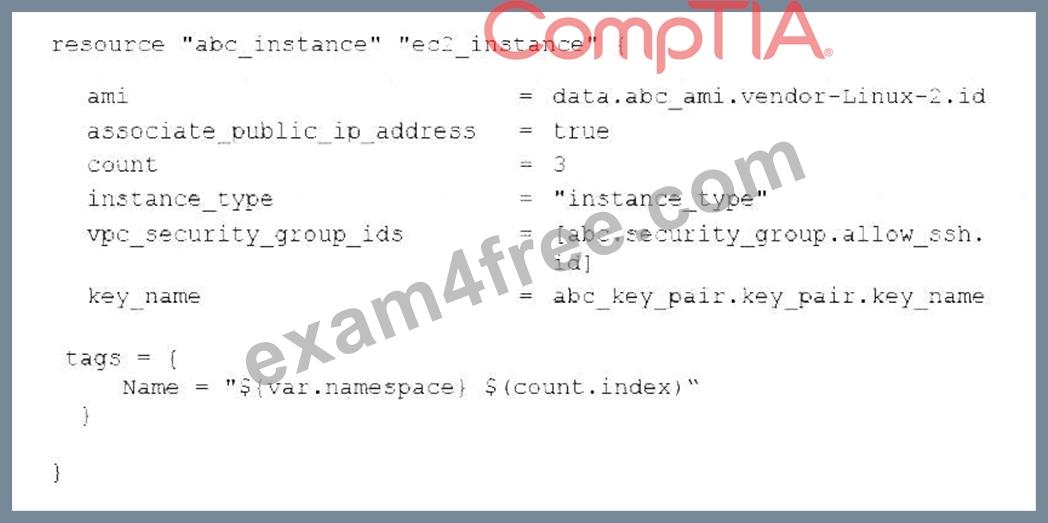
Which of the following technologies is the administrator using?
- A. Terraform
- B. Puppet
- C. Ansible
- D. Chef
Answer: A
Explanation:
Explanation
The code snippet is written in Terraform language, which is a tool for building, changing, and versioning infrastructure as code. Terraform uses a declarative syntax to describe the desired state of the infrastructure and applies the changes accordingly. The code defines a resource of type aws_instance, which creates an AWS EC2 instance, and sets the attributes such as the AMI ID, instance type, security group IDs, and key name. The code also uses a count parameter to create three identical instances and assigns them different names using the count.index variable. This is the correct technology that the administrator is using. The other options are incorrect because they use different languages and syntaxes for infrastructure as code. References: CompTIA Linux+ (XK0-005) Certification Study Guide, Chapter 19: Managing Cloud and Virtualization Technologies, page 559.
NEW QUESTION # 22
An issue was discovered on a testing branch of a Git repository. A file was inadvertently modified and needs to be reverted to the master branch version. Which of the following is the BEST option to resolve the issue?
- A. git checkout master -- file
- B. git branch -b master file
- C. git merge master testing
- D. git stash branch master
Answer: A
Explanation:
https://www.git-scm.com/book/en/v2/Git-Basics-Undoing-Things
NEW QUESTION # 23
A Linux administrator needs every new file created on a directory to maintain the group permissions of the same directory.
Which of the following commands would satisfy this requirement?
- A. chmod g+s <directory>
- B. chmod +s <directory>
- C. chmod u+s <directory>
- D. chmod o+s <directory>
Answer: A
Explanation:
"chmod g+s <directory>" is equal to "setgid <directory>"
This means that all NEW files (only new files and subdirectories) will have the same group of the directory that contains new files (rather of group of user made the file)
https://unix.stackexchange.com/questions/182212/chmod-gs-command
NEW QUESTION # 24
A systems administrator is tasked with installing GRUB on the legacy MBR of the SATA hard drive. Which of the following commands will help the administrator accomplish this task?
- A. grub-install /dev/hd0,0
- B. grub-install /dev/hda
- C. grub-install /dev/sda
- D. grub-install /dev/sr0
Answer: C
NEW QUESTION # 25
A systems administrator configured firewall rules using firewalld. However, after the system is rebooted, the firewall rules are not present: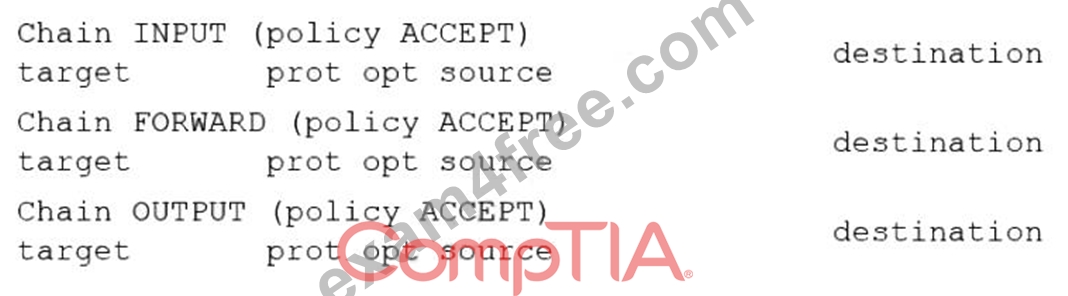
The systems administrator makes additional checks:
Which of the following is the reason the firewall rules are not active?
- A. The firewalld service is not enabled.
- B. iptables is conflicting with firewalld.
- C. The wrong system target is activated.
- D. FIREWALL_ARGS has no value assigned.
Answer: A
Explanation:
The reason the firewall rules are not active is that the firewalld service is not enabled. This means that the service will not start automatically at boot time or after a system reload. To enable the firewalld service, the systems administrator needs to use the command sudo systemctl enable firewalld. This will create a symbolic link from the firewalld service file to the appropriate systemd target, such as multi-user.target. Enabling the service does not start it immediately, so the systems administrator also needs to use the command sudo systemctl start firewalld or sudo systemctl reload firewalld to activate the firewall rules.
The other options are not correct reasons for the firewall rules not being active. iptables is not conflicting with firewalld, because firewalld uses iptables as its backend by default. The wrong system target is not activated, because firewalld is independent of the system target and can be enabled for any target. FIREWALL_ARGS has no value assigned, but this is not a problem, because FIREWALL_ARGS is an optional environment variable that can be used to pass additional arguments to the firewalld daemon, such as --debug or --nofork. If FIREWALL_ARGS is empty or not defined, firewalld will use its default arguments. Reference: firewalld.service(8) - Linux manual page; firewall-cmd(1) - Linux manual page; systemctl(1) - Linux manual page
NEW QUESTION # 26
A Linux administrator is reviewing changes to a configuration file that includes the following section: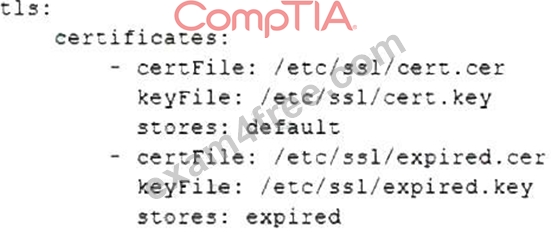
The Linux administrator is trying to select the appropriate syntax formatter to correct any issues with the configuration file. Which of the following should the syntax formatter support to meet this goal?
- A. Markdown
- B. YAML
- C. JSON
- D. XML
Answer: B
Explanation:
The configuration file shown in the image is written in YAML format, so the syntax formatter should support YAML to correct any issues with the file. YAML stands for YAML Ain't Markup Language, and it is a human-readable data serialization language that uses indentation and colons to define key-value pairs. YAML supports various data types, such as scalars, sequences, mappings, anchors, aliases, and tags. The configuration file follows the rules and syntax of YAML, while the other options do not. Markdown is a lightweight markup language that uses plain text formatting to create rich text documents. XML is a markup language that uses tags to enclose elements and attributes. JSON is a data interchange format that uses curly braces to enclose objects and square brackets to enclose arrays. References: CompTIA Linux+ (XK0-005) Certification Study Guide, Chapter 21: Automating Tasks with Ansible, page 591.
NEW QUESTION # 27
Users are unable to create new files on the company's FTP server, and an administrator is troubleshooting the issue. The administrator runs the following commands: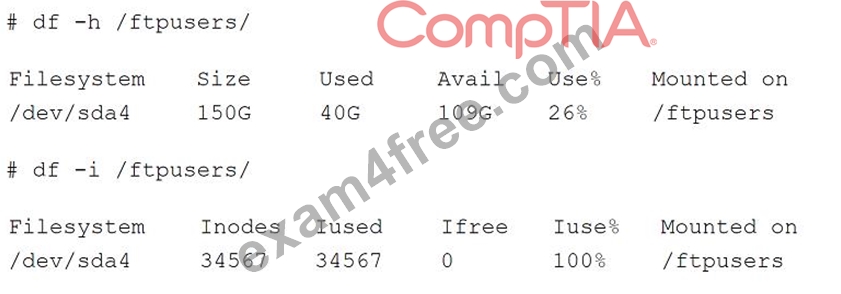
Which of the following is the cause of the issue based on the output above?
- A. The ftpusers filesystem does not have enough space.
- B. ftpusers is mounted as read only.
- C. The users do not have the correct permissions to create files on the FTP server.
- D. The inodes is at full capacity and would affect file creation for users.
Answer: D
Explanation:
The cause of the issue based on the output above is C. The inodes is at full capacity and would affect file creation for users.
An inode is a data structure that stores information about a file or directory, such as its name, size, permissions, owner, timestamps, and location on the disk. Each file or directory has a unique inode number that identifies it. The number of inodes on a filesystem is fixed when the filesystem is created, and it determines how many files and directories can be created on that filesystem. If the inodes are exhausted, no new files or directories can be created, even if there is enough disk space available.
The output for the second command shows that the /ftpusers/ filesystem has 0% of inodes available, which means that all the inodes have been used up. This would prevent users from creating new files on the FTP server. The administrator should either delete some unused files or directories to free up some inodes, or resize the filesystem to increase the number of inodes.
The other options are incorrect because:
A) The users do not have the correct permissions to create files on the FTP server.
This is not true, because the output for the first command shows that the /ftpusers/ filesystem has 26% of disk space available, which means that there is enough space for users to create files. The permissions of the files and directories are not shown in the output, but they are not relevant to the issue of inode exhaustion.
B) The ftpusers filesystem does not have enough space.
This is not true, because the output for the first command shows that the /ftpusers/ filesystem has 26% of disk space available, which means that there is enough space for users to create files. The issue is not related to disk space, but to inode capacity.
D) ftpusers is mounted as read only.
This is not true, because the output for the first command does not show any indication that the /ftpusers/ filesystem is mounted as read only. If it was, it would have an (ro) flag next to the mounted on column. A read only filesystem would prevent users from creating or modifying files on the FTP server, but it would not affect the inode usage.
NEW QUESTION # 28
Application code is stored in Gil. Due to security concerns, the DevOps engineer does not want to keep a sensitive configuration file, app.conf, in the repository. Which of the following should the engineer do to prevent the file from being uploaded to the repository?
- A. Add app.conf to .gitignore.
- B. Run git stash app.conf.
- C. Add app.conf to .exclude.
- D. Run git exclude app.conf.
Answer: A
Explanation:
This will prevent the file app.conf from being tracked by Git and uploaded to the repository.
The .gitignore file is a special file that contains patterns of files and directories that Git should ignore. Any file that matches a pattern in the .gitignore file will not be staged, committed, or pushed to the remote repository. The .gitignore file should be placed in the root directory of the repository and committed along with the other files.
NEW QUESTION # 29
A Linux administrator is providing a new Nginx image from the registry to local cache. Which of the following commands would allow this to happen?
- A. docker commit nginx
- B. docker pull nginx
- C. docker import nginx
- D. docker attach nginx
Answer: B
NEW QUESTION # 30
A cloud engineer needs to check the link status of a network interface named eth1 in a Linux server. Which of the following commands can help to achieve the goal?
- A. netstat -r eth1
- B. ifconfig hw eth1
- C. ip link show eth1
- D. ss -ti eth1
Answer: C
Explanation:
The ip link show eth1 command can be used to check the link status of a network interface named eth1 in a Linux server. It will display information such as the MAC address, MTU, state, and flags of the interface. The ifconfig hw eth1 command is invalid, as hw is not a valid option for ifconfig. The netstat -r eth1 command would display the routing table for eth1, not the link status.
The ss -ti eth1 command would display TCP information for sockets associated with eth1, not the link status.
NEW QUESTION # 31
A Linux administrator is configuring network traffic forwarding. Despite having proper iptables rules, the traffic forwarding is not working. Which of the following commands will allow Linux to pass network traffic between different interfaces?
- A. echo 'net.ipv4.ip_forward=1' >> /etc/sysctl.conf; sysctl -p
- B. ip route forward allow --all-interfaces; systemctl restart network
- C. modprobe ip_forward
- D. nmcli allow-forwarding eth0
Answer: A
Explanation:
To enable IP forwarding, the kernel parameter net.ipv4.ip_forward must be set to 1. This is done by appending net.ipv4.ip_forward=1 to /etc/sysctl.conf and applying the changes using sysctl -p.
This command ensures that the system can forward packets between different network interfaces.
NEW QUESTION # 32
A Linux administrator is troubleshooting an issue in which users are not able to access https://portal.comptia.
org from a specific workstation. The
administrator runs a few commands and receives the following output: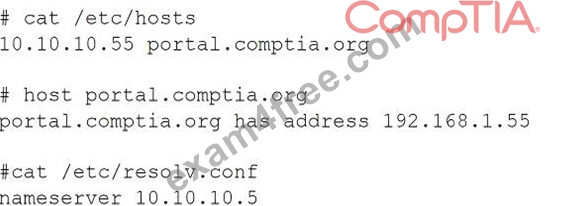
Which of the following tasks should the administrator perform to resolve this issue?
- A. Update the name server in resolv. conf to use an external DNS server.
- B. Clear the local DNS cache on the workstation and rerun the host command.
- C. Add a network route from the 10.10.10.0/24 to the 192.168.0.0/16.
- D. Remove the entry for portal . comptia.org from the local hosts file.
Answer: D
Explanation:
The best task to perform to resolve this issue is B. Remove the entry for portal.comptia.org from the local hosts file. This is because the local hosts file has a wrong entry that maps portal.comptia.org to 10.10.10.55, which is different from the actual IP address of 192.168.1.55 that is returned by the DNS server. This causes a mismatch and prevents the workstation from accessing the website. By removing or correcting the entry in the hosts file, the workstation will use the DNS server to resolve the domain name and access the website successfully.
To remove or edit the entry in the hosts file, you need to have root privileges and use a text editor such as vi or nano. For example, you can run the command:
sudo vi /etc/hosts
and delete or modify the line that says:
10.10.10.55 portal.comptia.org
Then save and exit the file.
NEW QUESTION # 33
A hardened physical Linux system allows regular, unprivileged users to remotely connect to the server using SSH only. No sudo tool has been installed. Which of the following should the Linux administrator use to perform administrative tasks on this host? (Select two).
- A. Create an SSH key and copy it to the remote server to allow passwordless login
- B. Install the telnet server on this system to be able to use a root account
- C. Add the user to the wheel group
- D. Access the server's physical console and use the root user's password to log in
- E. Install the sudo command using the unprivileged user's account
- F. Use the su command and enter the root user's password
Answer: D,F
Explanation:
As the sudo tool is not installed on the system, administrative tasks must be performed either via direct physical console access or by switching to the root user using the su command. Both methods require knowledge of the root password. Installing Telnet is not a good option due to its lack of security, and installing sudo using an unprivileged user is not possible without root privileges.
NEW QUESTION # 34
Users have been unable to reach www.comptia.org from a Linux server. A systems administrator is troubleshooting the issue and does the following: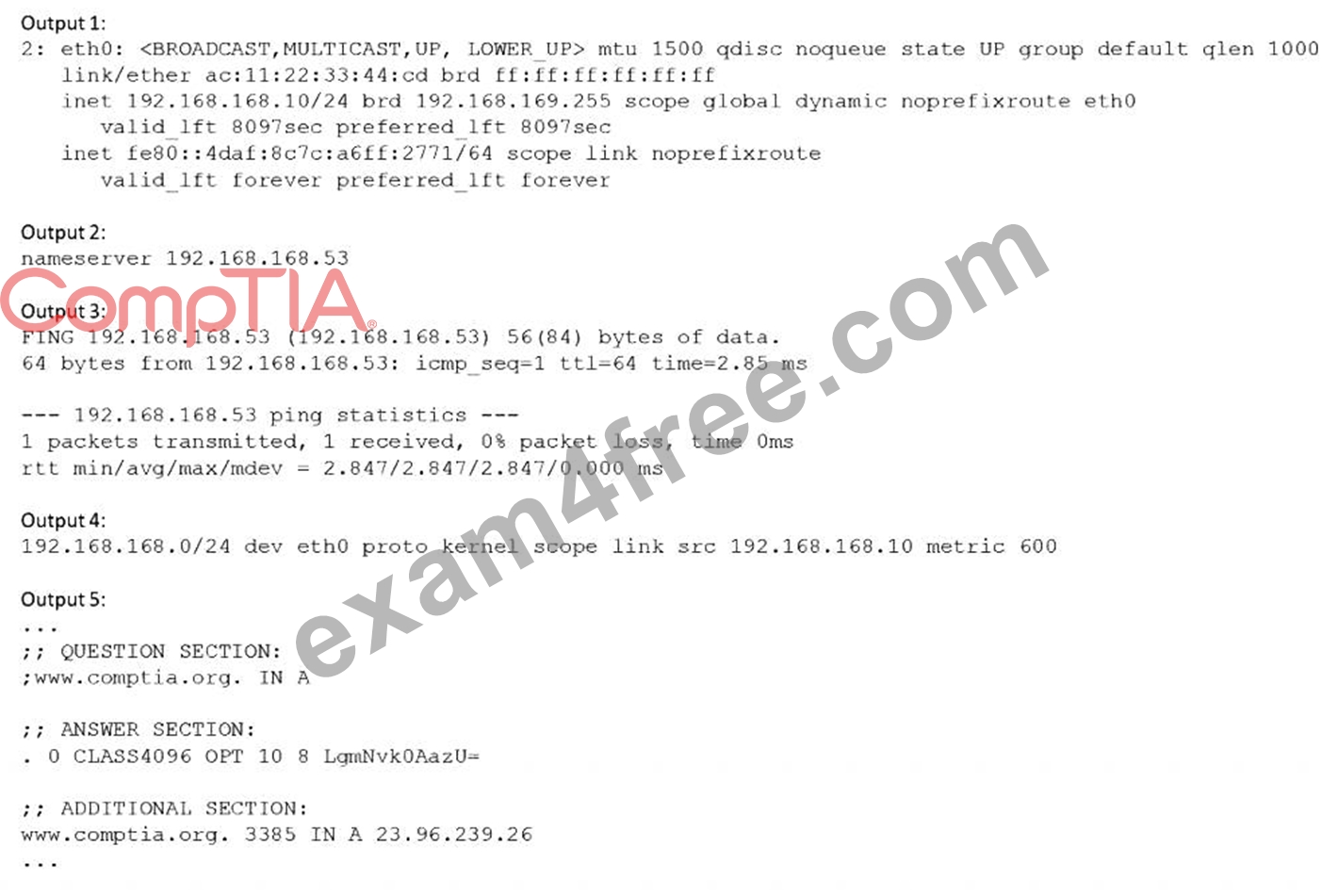
Based on the information above, which of the following is causing the issue?
- A. No default route is set on the server.
- B. The name www.comptia.org does not point to a valid IP address.
- C. The server 192.168.168.53 is unreachable.
- D. The network interface eth0 is disconnected.
Answer: C
Explanation:
Explanation
The issue is caused by the server 192.168.168.53 being unreachable. This server is the DNS server configured in the /etc/resolv.conf file, which is used to resolve domain names to IP addresses. The ping command shows that the server cannot be reached, and the nslookup command shows that the name www.comptia.org cannot be resolved using this server. The other options are incorrect because:
The name www.comptia.org does point to a valid IP address, as shown by the nslookup command using another DNS server (8.8.8.8).
The default route is set on the server, as shown by the ip route command, which shows a default gateway of 192.168.168.1.
The network interface eth0 is connected, as shown by the ip link command, which shows a state of UP for eth0. References: CompTIA Linux+ Study Guide, Fourth Edition, page 457-458, 461-462.
NEW QUESTION # 35
......
Latest 100% Passing Guarantee - Brilliant XK0-005 Exam Questions PDF: https://torrentvce.exam4free.com/XK0-005-valid-dumps.html
