
Pass CSI CSC1 With Exam4Free Exam Dumps - Updated on Aug-2025
Fully Updated CSC1 Dumps - 100% Same Q&A In Your Real Exam
NEW QUESTION # 13
Diana was appointed a senior vice president of the ABC inc. She is also a member of the board of XYZ Company where ABC inc, is a % stockholder. What best describes Diana's insider reporting obligations to the regulator?
- A. Report her trading activity Involving ABC Inc. stock only.
- B. Report her trading activity involving ABC Inc. stock and Issue a press re-case reporting tne holdings in XYZ Company.
- C. Report her trading activity involving XYZ Company stock only.
- D. Report her trading activity Involving both ABC inc. and XYZ Company stock.
Answer: D
Explanation:
As a senior executive at ABC Inc. and a board member of XYZ Company, Diana is considered an insider for both firms. Insiders are required to report any trading activity in securities of companies where they hold positions of influence. This ensures transparency and helps prevent insider trading.
* Option A:Press releases are not required for insider reporting.
* Option B:Incorrect; obligations apply to both companies.
* Option D:Incorrect; Diana's role at XYZ Company also imposes reporting requirements.
NEW QUESTION # 14
What is a common use of bond Indexes in the securities industry?
- A. Construction of bond index funds.
- B. Assess credit risk of individual bonds
- C. Provide liquidity for debt issuers.
- D. As a common investment tor direct purchase
Answer: A
Explanation:
Bond indexes are widely used in the securities industry to constructbond index funds, which aim to replicate the performance of the bond market or a specific segment of it.
* A (Provide liquidity)refers to market-making activities, not bond indexes.
* B (Direct purchase)is uncommon, as bond indexes are benchmarks rather than individual investments.
* D (Assess credit risk)is achieved through credit rating agencies, not bond indexes.
References:Volume 1, Chapter 7 ("Bond Indexes").
``
NEW QUESTION # 15
A politician promises to lower income taxes and increase government spending on social programs. but once selected her government's high debt level prevents her from doing so. Which challenge has this politician faced?
- A. Timing lags
- B. Political business cycle
- C. Unsynchronized fiscal and monetary policies.
- D. Co-ordination of federal, Provincial, and municipal policies
Answer: A
Explanation:
Timing lags refer to delays between the implementation of fiscal policy measures (such as tax cuts or increased government spending) and their impact on the economy. In this case, the politician's government was unable to implement the promised fiscal policies due to the high debt level, which delayed or negated the planned economic measures.
This reflects the challenge of timing lags in fiscal policy, where structural constraints (such as debt levels) prevent timely execution.
References:
* Volume 1, Chapter 5:Economic Policyunder "Challenges of Government Policy" discusses timing lags in implementing fiscal measures (CSC Volume 1, Chapter 5).
NEW QUESTION # 16
An emerging Canadian company is exploring the possibility of using hotwater springs to produce clear energy forremote rural communities.The company has strong human resource capital and few assets, and raised SI
20,000 through the Capital Pool Company program. Which option is best for this company to continue maximizing public exposure and raising capital?
- A. Escrowing shares
- B. offering a greenshee option
- C. Filling disclosure documents with SEDAR+.
- D. Crowfunding
Answer: D
Explanation:
For an emerging company with limited assets and innovative goals,crowdfundingis an excellent option to maximize public exposure and raise capital. Crowdfunding involves soliciting small investments from a large number of people, typically through online platforms, making it ideal for startups or innovative ventures like the use of hot water springs for clean energy.
Other options:
* Escrowing shares: Typically used to restrict the sale of shares for a certain period, not for raising capital.
* Offering a greenshoe option: Applies to stabilizing stock prices in an IPO or follow-on offering, not raising initial capital.
* Filing disclosure documents with SEDAR+: Necessary for public companies but does not directly raise capital or increase exposure.
References:
* Volume 1, Chapter 12:Financing and Listing Securities, section on "Capital Raising Options" covers crowdfunding as a method for startups to raise funds.
NEW QUESTION # 17
According to the Bankof Canada, approximately how many months does ittake for the effect of changes in monetary policy to be feltthrough the whole economy?
- A. 0
- B. 1
- C. 2
- D. 3
Answer: A
Explanation:
The Bank of Canada estimates that the effects of changes in monetary policy take approximately18 monthsto fully work through the entire economy. This lag exists because monetary policy impacts various sectors, such as consumer spending, business investment, and trade, at different speeds.
* B. 6 months: This is too short a timeframe for the full effects of monetary policy to materialize.
* C. 3 months: Immediate impacts may be seen in financial markets, but the broader economic effects require longer.
* D. 36 months: This is far longer than the typical lag for monetary policy effects.
NEW QUESTION # 18
What is the impact of a stock split on the number of shares held by the shareholders and theirprice?
- A. The number of shares Increases and theshare price Increases.
- B. The number of shares increases and the share price decreases.
- C. The number of shares decreases and the share price decreases.
- D. The number of shares decreases and the share price eases
Answer: B
Explanation:
Stock index performance is best measured usingpercentage changesrather than absolute values like point changes, relative values, or share price changes. This is because percentage changes provide a normalized measure of performance, allowing for meaningful comparisons over time or between different indexes, regardless of their starting levels or the specific units in which the index is expressed.
* Comparative Analysis: Percentage changes allow investors to compare the performance of indexes with vastly different base values or compositions. For example, a 100-point movement on a low-value index might be significant, while the same point movement on a high-value index might be trivial.
* Normalized Returns: They normalize the performance, enabling easier tracking of relative gains or losses over time.
* International Relevance: With global markets often using indexes based on different currencies or methodologies, percentage changes standardize comparisons across markets.
* A. Relative value changes: This term lacks a precise definition in the context of performance measurement and is not commonly used in evaluating index performance.
* B. Point changes: While point changes are informative for intraday movements or headlines, they lack context without knowing the index's value. For example, a 50-point drop could represent 0.5% or 5%, depending on the index level.
* C. Share price changes: This is specific to individual securities and does not apply to indexes, which aggregate multiple stocks.
Why Percentage Changes?Incorrect Options:Reference from the CSC® Study Material:The Canadian Securities Course explains the role of indexes in tracking market performance and highlights the importance of percentage changes for measuring and interpreting their performance. This is because percentage changes provide consistency and relevance when comparing different periods or indexes with varying base values (CSC Volume 1, Chapter 8, "Stock Indexes and Averages").
Key Concepts Related to Index Performance:
* Market indexes represent a basket of securities designed to reflect the overall performance of a specific market or sector.
* Percentage changes effectively capture market sentiment and performance trends.
* Common Canadian market indexes such as the S&P/TSX Composite Index and international indexes like the S&P 500 often report movements in both points and percentages, with the latter providing a more accurate representation of market dynamics.
This understanding is fundamental for financial professionals analyzing market trends, investment performance, and conducting portfolio management.
References:
* CSC Volume 1, Chapter 8, "Equity Securities: Common and Preferred Shares - Stock Indexes and Averages".
* CSC Volume 1, Chapter 7, "Fixed-Income Securities: Pricing and Trading - Bond Indexes" for comparative index concepts.
NEW QUESTION # 19
Based on market capitalization. which sector of the SSP.'TSX Composite index has one of the highest weightings withinthe index?
- A. Health care
- B. Energy
- C. Information technology
- D. Utilities
Answer: B
Explanation:
TheEnergy sectoris one of the highest-weighted sectors in theS&P/TSX Composite Indexbased on market capitalization. This reflects Canada's resource-rich economy, where energy companies, including oil, gas, and related services, make up a significant portion of the market.
Other options:
* Health care: A relatively small portion of the index.
* Utilities: Have a smaller weight compared to energy.
* Information technology: While growing, it has not surpassed energy in weight within the Canadian market.
References:
* Volume 1, Chapter 8:Equity Securities, section on "Canadian Market Indexes" outlines the composition and sectoral weightings of the S&P/TSX Composite Index.
NEW QUESTION # 20
How do high interest rates affect the economy?
- A. They decrease the value of the Canadian dollar.
- B. They reduce business investment.
- C. They increase prices
- D. They accelerate debt pay offs
Answer: B
Explanation:
High interest rates increase the cost of borrowing for businesses and consumers. For businesses, higher borrowing costs mean that financing for capital projects, expansions, or operational improvements becomes more expensive. This often leads to a reduction in investment activity, ultimately slowing economic growth.
For consumers, higher rates reduce disposable income and spending, indirectly affecting businesses by reducing demand for goods and services.
NEW QUESTION # 21
KJR made the following warrants offering: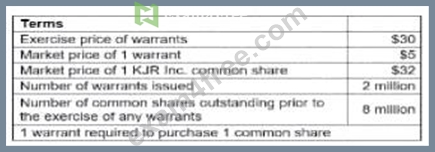
What is the intrinsic value of 1 KJR inc, warrant?
- A. $5
- B. $0
- C. $3
- D. $2
Answer: D
Explanation:
Theintrinsic valueof a warrant is calculated as the difference between the current market price of the common share and the exercise price of the warrant, provided the market price of the share is higher than the exercise price.
Intrinsic Value=Market Price of Common Share#Exercise Price of Warrant\text{Intrinsic Value} = \text
{Market Price of Common Share} - \text{Exercise Price of Warrant}
Intrinsic Value=Market Price of Common Share#Exercise Price of Warrant
Using the values provided:
* Market Price of 1 KJR Inc. Common Share= $32
* Exercise Price of Warrants= $30
Intrinsic Value=32#30=2\text{Intrinsic Value} = 32 - 30 = 2Intrinsic Value=32#30=2 Since the market price of the share is greater than the exercise price, the intrinsic value is$2.
Explanation of Incorrect Options:
* Option A ($0):This would be correct if the exercise price were greater than or equal to the market price of the common share.
* Option B ($5):This incorrectly includes the market price of the warrant ($5), which is irrelevant to intrinsic value calculation.
* Option D ($3):This is not derived from the given data and calculations.
References:
* Canadian Securities Course (CSC), Volume 1, Chapter 8: Equity Securities - Common and Preferred Shares. Discussion on warrants, including intrinsic value calculations.
NEW QUESTION # 22
An investor has earned additional Income and is looking to invest in a security that guarantees returns over.
The next seven years. What is the Best option for purchase?
- A. Exchange-traded fund.
- B. Common shares
- C. Proffered shares
- D. Provincial saving bond
Answer: D
Explanation:
Provincial savings bonds are a suitable option for an investor seeking a guaranteed return over a fixed period, such as seven years. These bonds are backed by the credit of the issuing provincial government and provide a stable and secure investment, ensuring predictable returns. They are often issued during specific sales campaigns and offer safety comparable to federal bonds but tailored to provincial residents.
Other options:
* Preferred shares: Provide fixed dividends but do not guarantee returns.
* Common shares: Subject to market risk and do not offer guaranteed returns.
* Exchange-traded funds (ETFs): Can track bonds or equities but are subject to market fluctuations and do not guarantee returns.
References:
* Volume 1, Chapter 6:Fixed-Income Securities, section on "Provincial and Municipal Bonds" explains the features and security of provincial savings bonds.
NEW QUESTION # 23
Which activity performed bythe Bank of Canada reflects role as the fiscal agent for the federal government?
- A. Working with domestic and international regulatory bodies
- B. Designing and distributing bank notes.
- C. Providing advice on debt Issuances based on its assessment of the capital markets.
- D. Preserving the value of the Canadian dollar by keeping inflation low
Answer: C
Explanation:
As the fiscal agent for the federal government, the Bank of Canada provides advice on debt management and issuance strategies, including assessments of capital markets. This role involves managing federal government debt and ensuring efficient market functioning.
References:
* Volume 1, Chapter 5:Economic Policyunder "The Role of the Bank of Canada" details the Bank's fiscal agent role in managing government debt (CSC Volume 1, Chapter 5).
NEW QUESTION # 24
When a futures contract is entered into, who sets the minimum initial margin rate?
- A. Seller
- B. investment dealer
- C. Buyer
- D. Exchange
Answer: D
Explanation:
Theexchangethat lists and trades the futures contract sets theminimum initial margin rate. This margin is required as collateral to ensure performance under the contract. The exchange determines this rate based on the volatility and risk of the underlying asset, and it is subject to adjustment depending on market conditions.
Other options:
* Investment dealer: Acts as a facilitator but does not set the margin rates.
* Buyer/Seller: Must meet the margin requirements but do not set them.
References:
* Volume 1, Chapter 10:Derivatives, section on "Futures Contracts" describes the role of exchanges in setting margin requirements.
NEW QUESTION # 25
What is a characteristicof provincial savings bonds that distinguishes them from other provincial bonds?
- A. They do not have redemption rules.
- B. They can be purchased at any time of the year.
- C. Theyare backed by provincial assetspledged an security.
- D. They can &e purchased only by residents of the province.
Answer: D
Explanation:
A key characteristic ofprovincial savings bondsis that they can only be purchased by residents of the issuing province. This restriction differentiates them from other provincial bonds, which may be available to investors nationwide or internationally.
Other options:
* Backed by provincial assets pledged as security: All provincial bonds are backed by the credit of the issuing government, not specifically by pledged assets.
* Purchased at any time of the year: Provincial savings bonds are available only during specific sales campaigns.
* Do not have redemption rules: Savings bonds often have specific redemption rules, unlike this statement.
References:
* Volume 1, Chapter 6:Fixed-Income Securities, section on "Provincial and Municipal Bonds" explains the restrictions and features of provincial savings bonds.
NEW QUESTION # 26
What is the portion of annual profit held by a company after the payment expenses and the distribution of dividends?
- A. Comprehensive income.
- B. Retained earnings
- C. Share capital.
- D. Gross profit
Answer: B
Explanation:
Retained earningsrepresent the portion of a company's annual profit that is retained and not paid out as dividends. It is used to reinvest in the business or pay down debt.
* B. Comprehensive incomeincludes all changes in equity except those from owner contributions or distributions.
* C. Share capitalrefers to funds raised by issuing shares.
* D. Gross profitis revenue minus the cost of goods sold, not the portion retained.
References:Volume 1, Chapter 11 ("Corporations and Their Financial Statements").
NEW QUESTION # 27
When sharesof GHI Inc. (GHI) traded at S50. aninvestor wrote five "GHI December 45" puts for a premium of $1,20. How much cash must the investor have in their account to be a cash-secured out writer?
- A. $24,400
- B. $22,500
- C. $25, 000
- D. $21,900
Answer: D
Explanation:
The investor wrote 5 put options ("GHI December 45") at a strike price of $45 with 100 shares per contract (5
× 100 = 500 shares). The cash-secured amount ensures the writer can cover the purchase if exercised:
* Obligation Amount:500 shares × $45 = $22,500.
* Premium Received:$1.20 × 500 = $600.
* Net Cash Requirement:$22,500 - $600 =$21,900.
This ensures the investor has enough funds to purchase the shares if the put options are exercised.
NEW QUESTION # 28
A fixed-rate bond was originally priced at $100 and paid $5 per year in interest. Currently,the bond is trading at $102.75. What is the impact on the current yield of coupon of the bond as a result of the change in price?
- A. The coupon is lower than 5%.
- B. The coupon is higher than 5%.
- C. The current yield is higher man 5%.
- D. The current yield is lower than 5%
Answer: D
Explanation:
Thecoupon rateof the bond remains fixed at5%, as it is based on the bond's original par value of $100.
Thecurrent yield, however, decreases because the bond's price has increased to $102.75. Current yield is calculated as:
Current Yield=Coupon PaymentCurrent Price\text{Current Yield} = \frac{\text{Coupon Payment}}{\text
{Current Price}}Current Yield=Current PriceCoupon Payment
Given:
* Coupon Payment= $5
* Current Price= $102.75
Current Yield=5102.75#4.87%\text{Current Yield} = \frac{5}{102.75} \approx 4.87\%Current Yield=102.
755#4.87%
* A. The coupon is higher than 5%: The coupon remains fixed at 5%.
* B. The current yield is higher than 5%: The current yield is lower than 5% due to the increased price.
* D. The coupon is lower than 5%: The coupon does not change with the bond's price.
NEW QUESTION # 29
What is the main benefit of investing in preferred shares?
- A. Higher potential for capital appreciation than common shares.
- B. Guaranteed dividend payment.
- C. Priority to claim assets ahead of debt holders.
- D. Priority to receive fixed dividends ahead of common shareholders.
Answer: D
Explanation:
Preferred shares provide investors withpriority to receive fixed dividends ahead of common shareholders.
This fixed income feature makes preferred shares similar to debt instruments but with characteristics of equity. While preferred shareholders have no guaranteed dividend payment (subject to the company's discretion and profitability), they are entitled to receive dividends before any distribution to common shareholders.
Preferred shares do not have a higher potential for capital appreciation compared to common shares, as they are typically designed for income rather than growth. Additionally, preferred shareholders have a lower claim on assets compared to debt holders.
NEW QUESTION # 30
What is unique to a shortmargin position?
- A. Short seller can suffer unlimited loss if the price of the security rises rather than fails.
- B. There is a timelimit that a short position may be maintained.
- C. Margin is established when the dealer memberloansmoney to the client.
- D. Margin is discretional for securities with certain price ranges.
Answer: A
Explanation:
A unique risk associated with short selling is the potential for unlimited loss. When a short seller borrows and sells a security in anticipation of its price falling, they must later buy it back to return it to the lender. If the security's price rises instead of falling, there is no theoretical limit to how high the price can go, leading to unlimited losses for the short seller.
This differs from long positions, where the maximum loss is limited to the initial investment amount.
Study Document References:
* Volume 1, Chapter 9:Short Margin Accounts, including the mechanics and risks of short selling.
NEW QUESTION # 31
What financial instrument is derived from thevalue of an underlying asset?
- A. Preferred share.
- B. Inflation linked bond
- C. Forward contract
- D. Real estate investment trust
Answer: C
Explanation:
Aforward contractis a derivative instrument whose value is derived from the value of an underlying asset, such as commodities, currencies, or financial instruments. It is a customized agreement between two parties to buy or sell an asset at a future date at a specified price.
* A. Real estate investment trust: A REIT is an equity instrument tied to real estate assets, not a derivative.
* C. Preferred share: A preferred share is an equity security with fixed dividends, not a derivative.
* D. Inflation-linked bond: These are fixed-income securities linked to inflation rates but are not considered derivatives.
NEW QUESTION # 32
What is the best way to measure the performance of stock indexes?
- A. Share price changes
- B. Percentage changes
- C. Point changes
- D. Relative value changes
Answer: B
Explanation:
Stock index performance is best measured usingpercentage changesrather than absolute values like point changes, relative values, or share price changes. This is because percentage changes provide a normalized measure of performance, allowing for meaningful comparisons over time or between different indexes, regardless of their starting levels or the specific units in which the index is expressed.
* Comparative Analysis: Percentage changes allow investors to compare the performance of indexes with vastly different base values or compositions. For example, a 100-point movement on a low-value index might be significant, while the same point movement on a high-value index might be trivial.
* Normalized Returns: They normalize the performance, enabling easier tracking of relative gains or losses over time.
* International Relevance: With global markets often using indexes based on different currencies or methodologies, percentage changes standardize comparisons across markets.
* A. Relative value changes: This term lacks a precise definition in the context of performance measurement and is not commonly used in evaluating index performance.
* B. Point changes: While point changes are informative for intraday movements or headlines, they lack context without knowing the index's value. For example, a 50-point drop could represent 0.5% or 5%, depending on the index level.
* C. Share price changes: This is specific to individual securities and does not apply to indexes, which aggregate multiple stocks.
Why Percentage Changes?Incorrect Options:Reference from the CSC® Study Material:The Canadian Securities Course explains the role of indexes in tracking market performance and highlights the importance of percentage changes for measuring and interpreting their performance. This is because percentage changes provide consistency and relevance when comparing different periods or indexes with varying base values (CSC Volume 1, Chapter 8, "Stock Indexes and Averages").
Key Concepts Related to Index Performance:
* Market indexes represent a basket of securities designed to reflect the overall performance of a specific market or sector.
* Percentage changes effectively capture market sentiment and performance trends.
* Common Canadian market indexes such as the S&P/TSX Composite Index and international indexes like the S&P 500 often report movements in both points and percentages, with the latter providing a more accurate representation of market dynamics.
This understanding is fundamental for financial professionals analyzing market trends, investment performance, and conducting portfolio management.
References:
* CSC Volume 1, Chapter 8, "Equity Securities: Common and Preferred Shares - Stock Indexes and Averages".
* CSC Volume 1, Chapter 7, "Fixed-Income Securities: Pricing and Trading - Bond Indexes" for comparative index concepts.
NEW QUESTION # 33
Haw are retail stock and bond transactions settledon a daily basis amongdealers?
- A. The exchange is responsible for settling all transactions according to each exchange's book of record.
- B. The clearing corporation is responsible for setting an transactions according to each exchange's book of record.
- C. The exchange is responsible for settling ad transactions according to each dealer's book of record.
- D. The clearing corporation is responsible for settling all transactions according to each dealer's book of record.
Answer: D
Explanation:
In Canada, retail stock and bond transactions are settled through aclearing corporation, such as the Canadian Depository for Securities (CDS). The clearing corporation ensures that transactions are accurately settled according to the dealers' records.
* Exchanges facilitate the trading process but are not directly responsible for settling transactions (A, D).
* The clearing corporation settles transactions based on dealer records, not exchange records (B).
References:Volume 1, Chapter 7 ("Clearing and Settlement").
NEW QUESTION # 34
Why does thefederalgovernment borrow from the capital markets?
- A. To raise capital for streets, servers and waterworks
- B. To support the expansion of corporations
- C. To fund spending In excess of revenues
- D. To support The capital markets
Answer: C
Explanation:
The federal government borrows from the capital markets to cover budget deficits, which occur when government spending exceeds its revenues. Borrowing is done through the issuance of fixed-income securities such as Treasury bills, bonds, and notes. This process enables the government to fund public services, programs, and infrastructure projects without immediately raising taxes.
* A. To raise capital for streets, sewers, and waterworks: While such projects are funded by borrowing, they are typically under the purview of municipal or provincial governments rather than the federal government.
* B. To support the capital markets: This is an indirect result but not the primary reason for borrowing.
* D. To support the expansion of corporations: Corporate expansion is financed through private or corporate capital markets, not federal borrowing.
NEW QUESTION # 35
A bond with a duration of five is currently priced at $103. If Interestrates rise by 2%. approximately what win be me bond's price?
- A. $108.15
- B. $97.85
- C. $92.70
- D. $113.30
Answer: B
Explanation:
The approximate price change of a bond due to a change in interest rates can be estimated using the formula:
Price Change (%)=#Duration×#Interest Rate\text{Price Change (\%)} = - \text{Duration} \times \Delta \text
{Interest Rate}Price Change (%)=#Duration×#Interest Rate
Given:
* Duration= 5
* Current Price= $103
* Change in Interest Rate(#\Delta#) = 2% or 0.02
Price Change (%)=#5×0.02=#0.10 (#10%)\text{Price Change (\%)} = -5 \times 0.02 = -0.10 \, (-10\%) Price Change (%)=#5×0.02=#0.10(#10%) The new price is calculated as:
New Price=Current Price×(1+Price Change)=103×(1#0.10)=103×0.90=97.85\text{New Price} = \text
{Current Price} \times (1 + \text{Price Change}) = 103 \times (1 - 0.10) = 103 \times 0.90 = 97.85 New Price=Current Price×(1+Price Change)=103×(1#0.10)=103×0.90=97.85
* A. $108.15andB. $113.30: These represent price increases, which are incorrect for rising interest rates.
* D. $92.70: This reflects a greater-than-actual price drop, which is inconsistent with the duration-based calculation.
NEW QUESTION # 36
......
Latest CSC1 Exam Dumps - Valid and Updated Dumps: https://torrentvce.exam4free.com/CSC1-valid-dumps.html
